
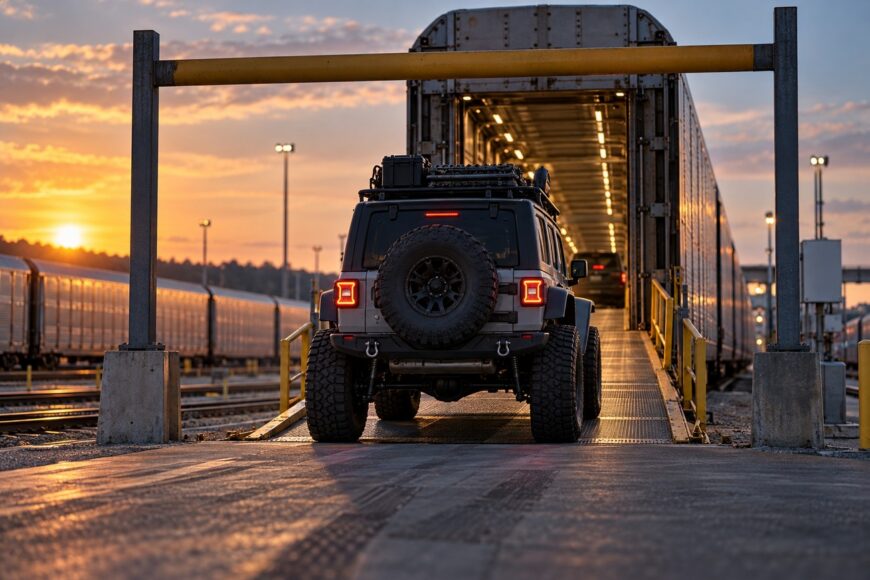
A lifted Jeep Wrangler may fit on Amtrak Auto Train, but the suspension lift alone does not determine acceptance. Amtrak’s published maximum height is 85 inches (215.9 cm), and that measurement includes roof racks and other equipment mounted on the roof.
The relevant figure is the Wrangler’s complete travel configuration: its installed top, antenna, roof equipment, light bar, spare tire, mirrors, tires, bumpers, and any load. A Jeep that appears to fit in a listing or passes online booking can still face a terminal inspection and rejection if its actual dimensions or aftermarket equipment fall outside the applicable limits.
- The 85-Inch Height Rule Is Only the Starting Point
- Amtrak Auto Train Limits for a Lifted Wrangler
- How to Measure Your Wrangler Before Booking
- Why Width, Length, and the Loading Ramp Can Still Stop You
- Booking, Oversized Check-In, and Terminal Inspection
- The 65-Inch Claim and Other Lifted-Wrangler Myths
- Frequently asked questions
- What should I do if Amtrak rejects my Wrangler at the terminal?
- What is the size limit for vehicles on Amtrak Auto Train?
- What is the Amtrak 750-mile rule?
The 85-Inch Height Rule Is Only the Starting Point
Amtrak’s maximum vehicle height is 85 inches (215.9 cm), including roof racks and other equipment mounted on the roof. Measure to the highest installed point, which may be an antenna, roof rack, rooftop tent, light bar, or another accessory rather than the Wrangler’s roof itself.
A suspension lift changes the vehicle’s stance, but it does not provide a reliable final height by itself. Tire size, tire pressure, fuel, luggage, the installed top, and the position of removable equipment can all affect the measurement. A soft top and a hardtop also create different travel configurations, so measure the version that will arrive at the terminal.
The safe decision comes from measuring the complete vehicle against every applicable limit. A general estimate from a seller, transporter, or online chart cannot replace confirmation for a modified Wrangler. Online booking also does not guarantee terminal acceptance or loading of an unusual aftermarket configuration.
Before committing to the trip, record the Wrangler’s VIN, exact equipment list, measured dimensions, and photographs of the vehicle. Use that information when requesting written confirmation from Amtrak, especially if the Jeep has a roof rack, oversize tires, aftermarket bumpers, or unusually wide mirrors.
Amtrak Auto Train Limits for a Lifted Wrangler
These are the dimensions to check against the Wrangler in its transport configuration. External equipment is part of the relevant measurement where specified.
| Measurement | Amtrak limit | What to include | Wrangler items that may cause problems |
|---|---|---|---|
| Height | 85 inches (215.9 cm) | Roof racks and other equipment mounted on the roof, plus the highest installed point | Lifted suspension, hardtop, soft-top hardware, antenna, light bar, roof rack, or rooftop tent |
| Width | 84 inches (213.4 cm), including mirrors | Mirrors and the vehicle’s widest installed components | Large mirrors, fender flares, beadlock combinations, wide wheels, and tires |
| Ground clearance | At least 4 inches (10.2 cm) | The lowest part of the vehicle in its travel condition | Low-hanging bumpers, skid plates, hitch equipment, or other underbody parts |
| Tire width | 14.5 inches maximum | The actual width of each tire, rather than the marketing size | Wide aftermarket tires and beadlock combinations |
| Standard vehicle length | 192 inches (16 feet) | External equipment and rear-mounted components | Spare tire, rear bumper, hitch carrier, cargo carrier, or other extensions |
| Extended vehicle length | 216 inches (18 feet) | External equipment and the full end-to-end vehicle length | Long-body configurations, rear accessories, and equipment extending beyond the bumpers |
How to Measure Your Wrangler Before Booking
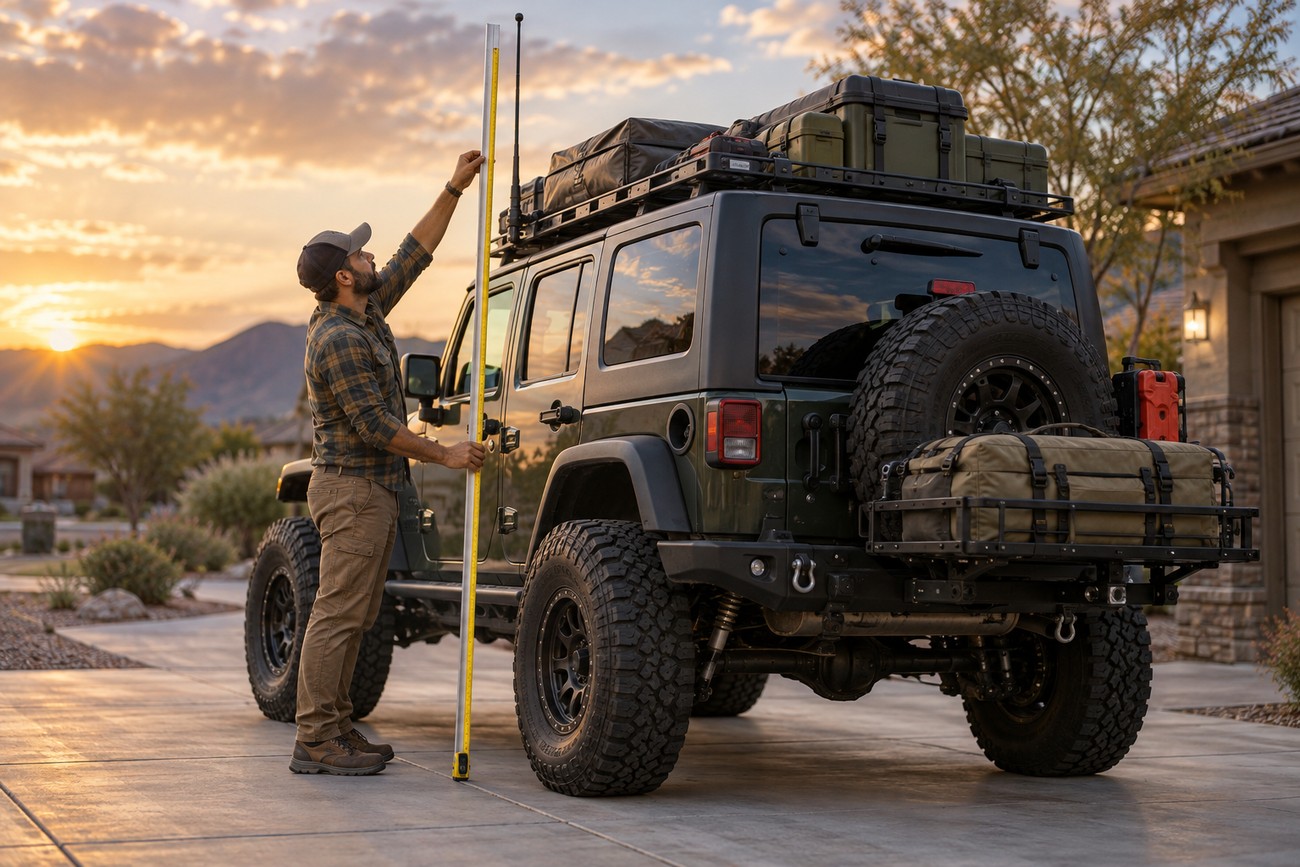
Measure the Jeep on level ground with the fuel, luggage, and equipment it will carry to the terminal. Set the tires to the travel pressure you will use, install the top and antenna, and leave roof racks, light bars, spare tires, bumpers, and hitch carriers in place. The result should represent the vehicle as it will actually arrive for transport.
For height, measure from the ground to the highest installed point. A helper and a straightedge can make the top measurement more consistent, particularly around an antenna or roof-mounted accessory. Measure the hardtop or soft top in its installed condition, and do not subtract equipment simply because it could be removed later unless you will remove it before check-in.
Measure width across the widest parts, including mirrors. Check fender flares, wheel position, side steps, beadlock hardware, and tires rather than relying on the factory body specification. If the mirrors extend beyond 84 inches (213.4 cm), treat mirror removal as a separate preparation task; it does not make other wide components acceptable.
Measure each tire’s actual width at the section that creates the widest profile. A label such as “35-inch tire” describes diameter, not the full width relevant to Amtrak’s 14.5-inch tire-width limit. Wheel choice, inflation, sidewall shape, and beadlock hardware can change the result.
Check length from the foremost to the rearmost installed point, including the spare tire, rear bumper, hitch carrier, and cargo equipment. Then check the lowest point for at least 4 inches (10.2 cm) of ground clearance. Keep photographs of every measurement and the complete vehicle configuration so the written approval request describes the same Jeep that will reach the terminal.
Why Width, Length, and the Loading Ramp Can Still Stop You
Passing the height test does not establish compliance. The maximum width is 84 inches (213.4 cm), including mirrors, and wide fender flares, wheels, tires, or aftermarket mirrors can push a Wrangler beyond that limit even when its roof is below 85 inches.
If the mirrors exceed the width limit, Amtrak requires at least one mirror to be removed before loading. Mirror removal addresses the mirror measurement only; it does not change the limits for the body, fender flares, wheels, tires, or other protruding equipment. Store the mirror and hardware securely, and make sure the Jeep can be made road-safe after unloading.
Length requires its own check. The standard vehicle limit is 192 inches (16 feet), including external equipment, while the extended vehicle limit is 216 inches (18 feet), also including external equipment. A rear-mounted spare tire, bumper, hitch carrier, or cargo accessory can be the component that changes the applicable measurement.
Static clearance is only part of the loading problem. A lifted Wrangler can have ample ground clearance yet approach a ramp at an angle that brings a long bumper, hitch assembly, or other equipment into contact. The vehicle must have at least 4 inches (10.2 cm) of ground clearance and enough approach and departure geometry to pass the loading ramp safely.
Booking, Oversized Check-In, and Terminal Inspection
Oversized-vehicle registration begins at 11:30 a.m. and ends at 2:00 p.m. The check-in deadline for other vehicles is 2:30 p.m. Amtrak does not promise exceptions, so arriving near the cutoff leaves little time to remove a mirror, reposition equipment, or resolve a measurement issue.
Request written confirmation for the specific Wrangler before traveling. Include the VIN, installed top, suspension and tire details, measured height, width, length, tire width, ground clearance, and every roof or exterior accessory. Ask Amtrak to confirm the applicable vehicle category and whether the described configuration can be accepted.
Document the VIN, photographs, measured dimensions, and every removable accessory before seeking approval. A verbal “it should fit” leaves no reliable record when the terminal sees a different configuration or applies a measurement on site.
Bring the same configuration shown in the approval request. If a mirror must be removed, carry the correct tools, protect the mirror during transport, and have a plan for reinstallation after unloading. Removing a mirror may solve a loading issue while creating a road-safety problem at the destination if the mirror cannot be restored promptly.
A terminal refusal can create an immediate transportation problem because the Jeep and its occupants have already reached the departure point. Leave enough time before the deadline to document the decision, contact Amtrak, and arrange an alternative rather than relying on a last-minute exception.
The 65-Inch Claim and Other Lifted-Wrangler Myths
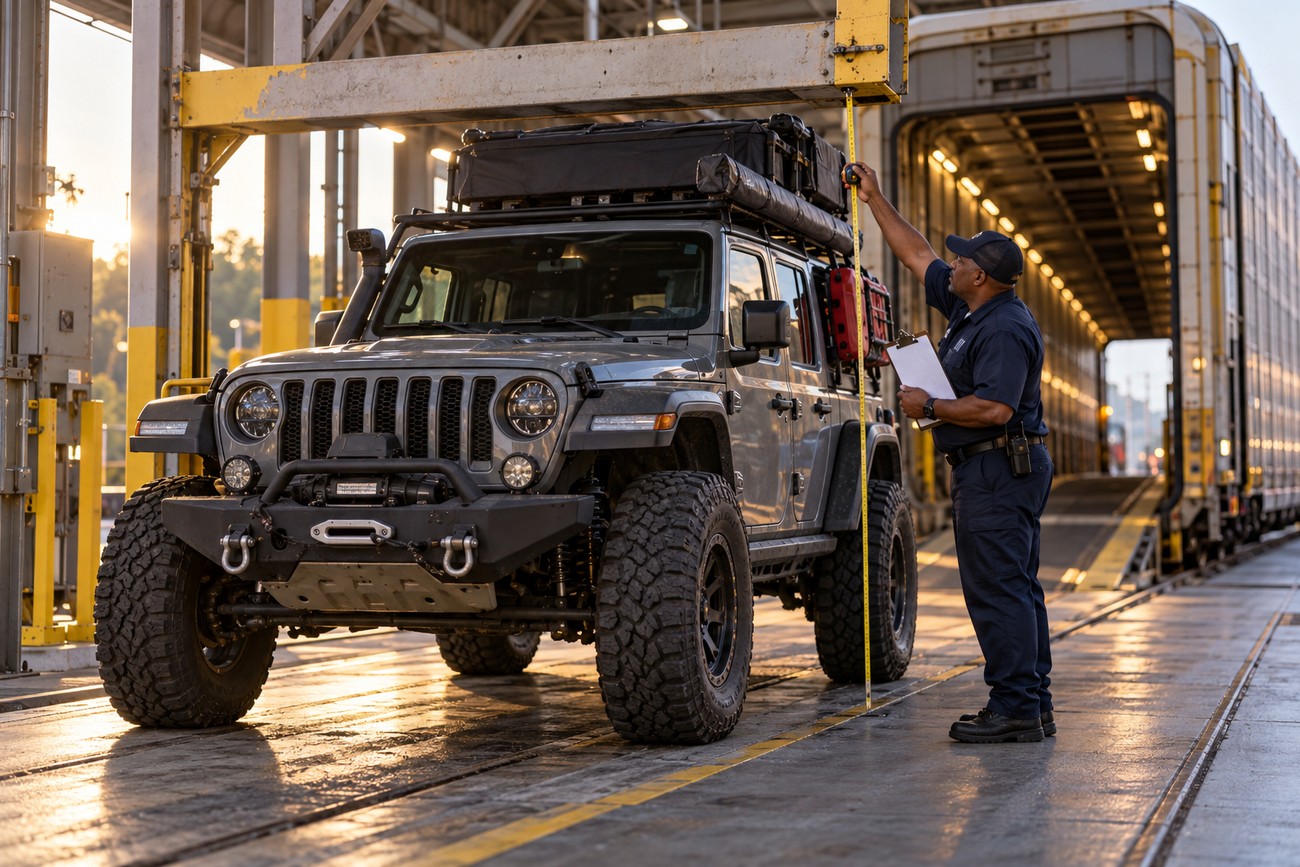
Myth: every lifted Wrangler automatically fails. Reality: Amtrak’s published maximum vehicle height is 85 inches (215.9 cm), and a lifted Wrangler is not automatically disqualified if its complete measured configuration meets the applicable limits.
Myth: a 65-inch limit always applies. Some commercial materials cite 65 inches for a “standard vehicle,” while Amtrak’s published maximum height is 85 inches (215.9 cm). A commercial or SEO chart cannot classify a modified Wrangler; use Amtrak’s vehicle category, booking confirmation, and written review of the actual configuration.
Myth: height is the only measurement that matters. The Wrangler must also satisfy the 84-inch (213.4 cm) maximum width, including mirrors, the length category, the 14.5-inch maximum tire width, and the minimum 4-inch (10.2 cm) ground clearance. Ramp geometry and the safe passage of exterior equipment remain relevant even when the static measurements appear compliant.
Myth: successful online booking guarantees loading. A completed booking records a reservation, while an unusual aftermarket configuration may still receive separate terminal review. Treat the booking as incomplete from a risk-management perspective until Amtrak has confirmed the VIN and full equipment description in writing.
Frequently asked questions
What should I do if Amtrak rejects my Wrangler at the terminal?
Ask for the reason for refusal and record the measured dimension or equipment issue if the terminal provides it. Photograph the Jeep in its arrival configuration, keep the booking details and written approval request, and note the time and staff instructions. Avoid removing equipment in a rushed manner unless Amtrak confirms that the change would make the vehicle acceptable and you can complete it safely.
Protect the Jeep while arranging an alternative. Confirm where it can remain legally and securely, keep personal items with you, and contact a vehicle transporter, rental provider, or other backup service before making a costly decision. If a mirror or accessory was removed, restore the vehicle to a safe road configuration before driving away.
What is the size limit for vehicles on Amtrak Auto Train?
Amtrak’s published limits include a maximum height of 85 inches (215.9 cm), a maximum width of 84 inches (213.4 cm), including mirrors, a minimum ground clearance of 4 inches (10.2 cm), and a maximum tire width of 14.5 inches. Standard vehicle length is limited to 192 inches (16 feet), while extended vehicle length is limited to 216 inches (18 feet).
Those figures describe the relevant measurements rather than guaranteeing acceptance of every modified vehicle. Roof equipment, mirrors, tires, bumpers, spare tires, and hitch carriers can change the result, and a specific lifted Wrangler should receive written confirmation based on its VIN and complete configuration.
What is the Amtrak 750-mile rule?
The 750-mile rule is a separate distance-related policy question. It does not replace the Auto Train checks for height, width, length, tire width, ground clearance, equipment, or ramp access.
For a lifted Wrangler, resolve the distance-related requirement separately and continue checking the vehicle dimensions. A route or distance policy cannot make an oversize or improperly configured vehicle eligible for loading.







