
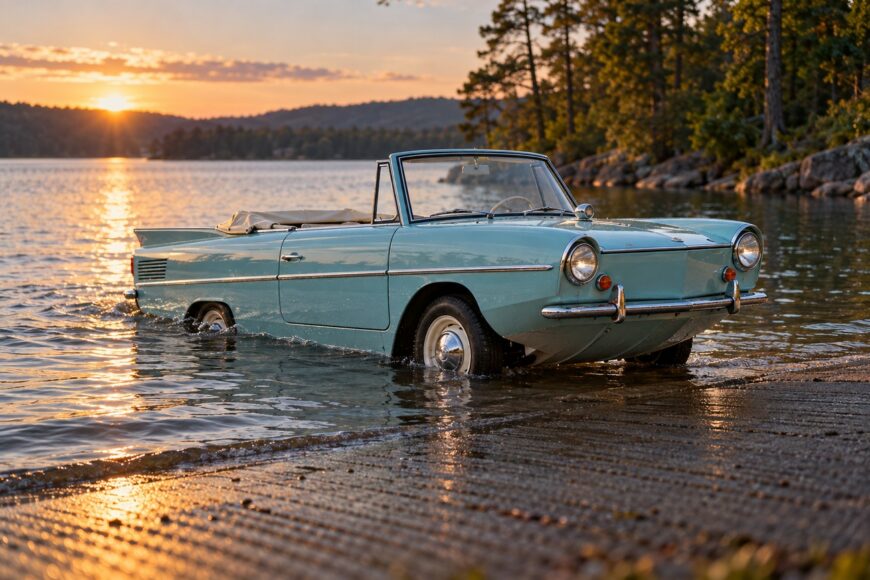
The Amphicar 770 really floats, yet floating is only the beginning of the story. Its famous road-and-water promise comes with a water speed of roughly 7 mph, a heavy steel hull exposed to corrosion, and a maintenance burden closer to that of a small boat than an ordinary convertible.
That tension explains the car’s appeal and its risks. The Amphicar was engineered as a genuine amphibious vehicle, with a sealed, buoyant body and separate water propulsion, but its usable performance depends on seals, welds, pumps, drive penetrations, and post-launch care. Understanding how those systems work matters more than repeating its most attractive advertising figures.
- What the Amphicar 770 Really Was
- Amphicar 770 at a Glance: Road Versus Water
- How the Amphicar Moves on Water
- The Hidden Maintenance Burden of a Floating Car
- Buying or Restoring an Amphicar: What a Road Test Misses
- The Myths Behind the Amphicar 770
- Frequently asked questions
- What is an Amphicar 770 worth today?
- How many Amphicars are left?
- Why did the Amphicar fail?
What the Amphicar 770 Really Was
The Amphicar was a purpose-built amphibious vehicle, not a conventional car fitted with a bolt-on water kit. Its steel load-bearing convertible body incorporated a sealed hull designed to provide buoyancy, while the rear-mounted engine drove the car on land and supported a separate propulsion system for water use.
That construction made the Amphicar structurally distinctive and mechanically complicated. The body had to function as an automobile shell, a passenger compartment, and a watertight hull. Every seam, door seal, and drive penetration therefore carried consequences beyond normal automotive weather protection.
Power came from a rear-mounted Triumph inline four displacing 1,147 cc and producing approximately 43 hp. A four-speed manual transmission handled road travel, while the water system used two stern propellers. The layout gave the Amphicar genuine dual-use capability, although the compromises of combining both roles remained substantial.
Production figures require careful wording. The period is commonly stated as 1961–1968, while some catalogs place actual manufacture mainly in 1961–1965; later catalog, registration, or sales dates may account for part of that difference. Museum sources commonly cite 3,878 cars built, making a complete, usable water system more significant than a simple claim that a car is one of the surviving examples.
Amphicar 770 at a Glance: Road Versus Water
The Amphicar’s headline numbers describe two very different machines sharing one body. Road speed is automotive; water speed is closer to that of a small displacement boat moving a heavy hull.
| System | Road operation | Water operation |
|---|---|---|
| Engine | Rear-mounted Triumph inline four, 1,147 cc, approximately 43 hp | The same engine supplies the vehicle’s power |
| Transmission or propulsion | Four-speed manual transmission driving the road system | Two stern propellers driven in a separate water mode |
| Approximate maximum speed | Approximately 65–70 mph | Approximately 6.5–7 knots, or about 7 mph, as the practical baseline |
| Higher water-speed claim | Not applicable | Some descriptions claim up to 10 knots, but this is a disputed or exceptional figure |
| Meaning of “770” | A rounded reference to approximately 70 mph on land and 7 knots on water; it does not indicate a 770 cc engine or an official vessel class | |
The figures show why the Amphicar’s name is memorable while its water performance is easy to misread. It can cover road distances at normal vintage-car speeds, then move through water slowly enough that current, wind, and traffic from ordinary boats become practical considerations.
How the Amphicar Moves on Water
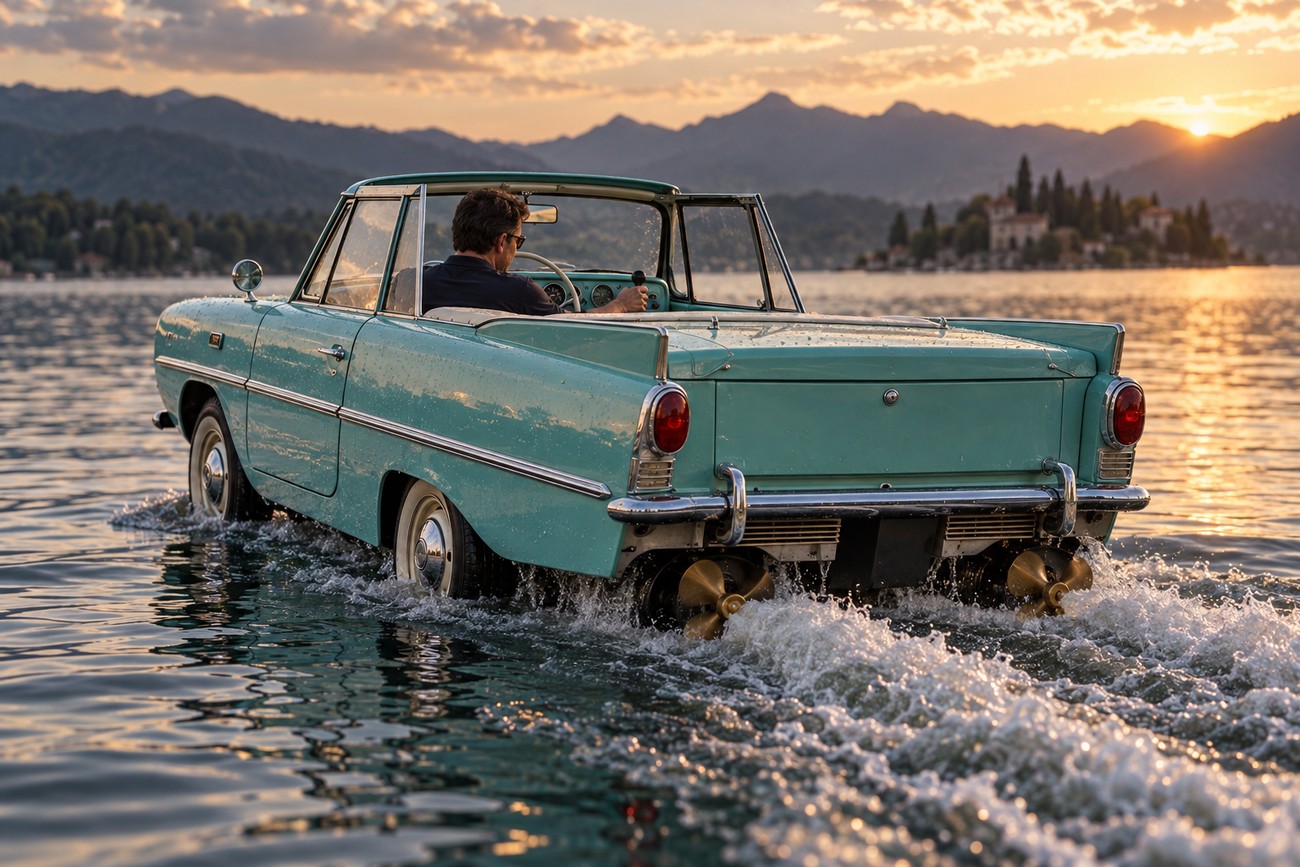
Once afloat, the Amphicar does not rely on its road wheels for thrust. The wheels remain part of the automotive layout, while two rear propellers provide the force that moves the hull through the water.
A separate water-driving mode engages the aquatic propulsion system. Forward and reverse operation use the water system rather than treating the road gearbox as a marine transmission. The changeover is therefore a mechanical procedure that deserves inspection on any car intended for actual launches.
The hull’s weight and shape limit acceleration, maneuverability, and speed. A heavy steel body carrying automotive equipment has more resistance than a purpose-designed lightweight boat, and the convertible structure brings additional sealing demands. A practical working figure is approximately 6.5–7 knots, or about 7 mph.
Some descriptions claim up to 10 knots, but that number is a poor baseline for planning a trip. Owners and buyers should treat roughly 7 mph as the safer practical reference and allow for conditions, loading, current, and the individual car’s mechanical state.
The Hidden Maintenance Burden of a Floating Car
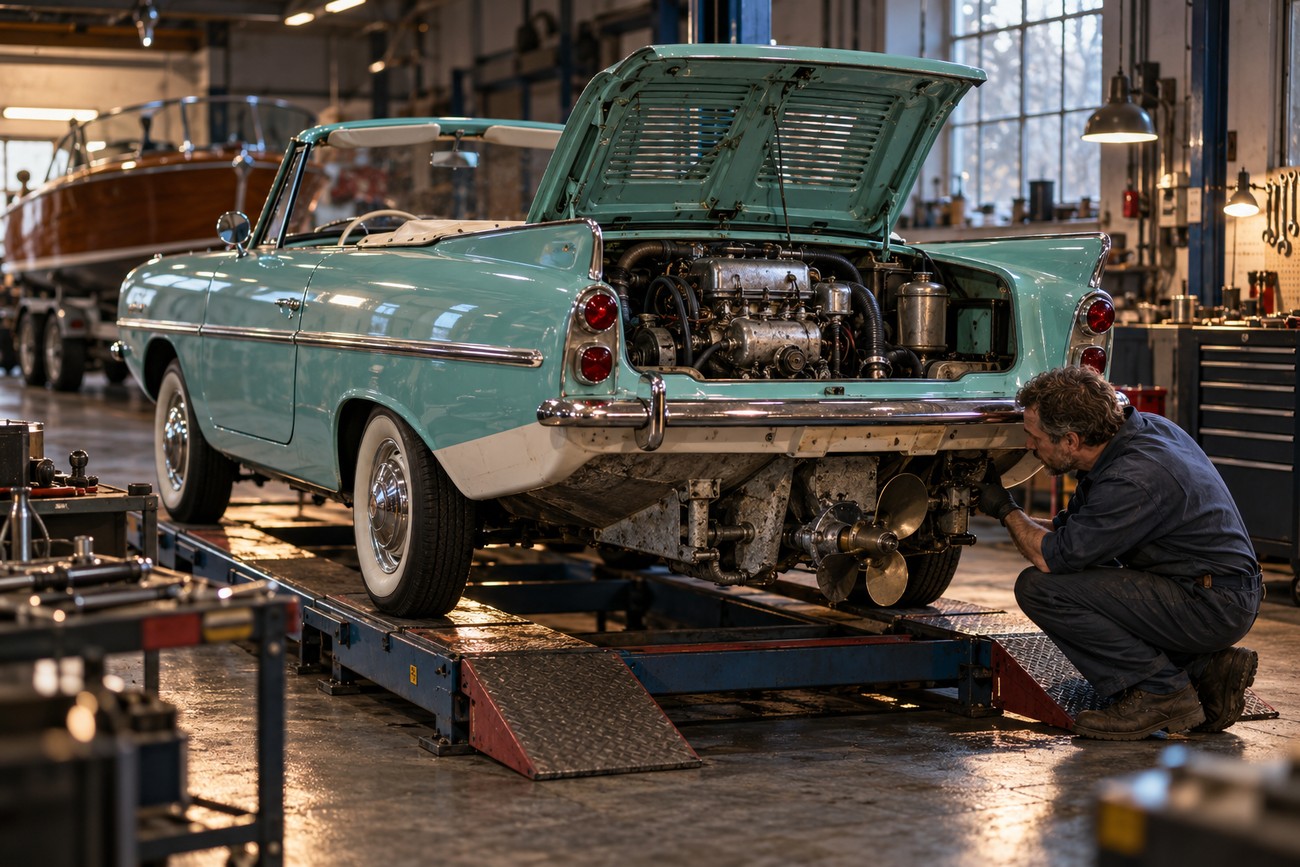
The hull is the first maintenance issue because steel must survive both ordinary automotive exposure and water-related corrosion. The underside, welded seams, door seals, drive penetrations, and other hull-related areas deserve inspection before attention turns to paint or engine presentation.
A sealed hull can still admit water through aged seals, deteriorated weld areas, or openings around the drive system. Bilge pumps and fittings add another layer of responsibility. A car that starts easily and drives well may still be unsuitable for launching if its water-removal system is weak or its hull integrity is uncertain.
Water ingress should be judged over a timed interval, with the pump’s ability to remove that water verified; a brief float test alone does not establish hull integrity.
After water use, the relevant points require inspection, rinsing or drying as appropriate, and lubrication. Access to some lubrication points can be inconvenient and may require removal of the rear seat, which turns routine care into a planned service operation rather than a quick wipe-down.
The practical question is how much water enters the hull during a defined period and whether the bilge system can remove it reliably. Propeller hardware, fittings, seals, and hull areas all contribute to that answer, so marine-system checks cannot be replaced by a road test.
Buying or Restoring an Amphicar: What a Road Test Misses
A road test confirms only part of an Amphicar’s condition. The engine, clutch, gearbox, steering, and brakes may perform acceptably while the hull, seals, pumps, propellers, and water-mode controls remain untested.
Begin with the hull and its corrosion-prone areas. Inspect the underside, welded seams, door seals, and drive penetrations separately from the engine bay. Evidence of fresh paint or a clean interior should prompt closer examination because cosmetic restoration can conceal work that has not addressed structural sealing.
The water system needs its own functional check. That includes propeller operation, forward and reverse in water mode, bilge-pump function, fittings, and actual watertightness. A controlled test by someone familiar with the vehicle is more informative than an assumption based on a previous owner’s claim that the car “floats.”
Documentation also matters. Restoration records should identify work on the hull and marine components, while launch history can help establish whether the water system has been maintained or merely preserved for display. Individual identification and condition deserve more weight than a universal specification sheet because published power, dates, and water-speed figures can vary.
With fewer than 4,000 cars built, a sound and properly tested water system may matter more to usability and rarity than perfect paint. A mechanically healthy road car with dormant marine equipment can require substantial additional work before it becomes a functioning amphibian.
The Myths Behind the Amphicar 770
The “770” designation does not describe engine displacement. The engine is a 1,147 cc Triumph inline four, while the name refers to the rounded idea of approximately 70 mph on land and 7 knots on water.
The 10-knot figure also needs qualification. Some descriptions use it, but museum-style technical data more commonly places practical water speed at approximately 6.5–7 knots, or about 7 mph. The lower figure is the more useful reference for planning, comparison, and inspection.
A sealed, buoyant body does not make the Amphicar maintenance-free after water use. Corrosion control, seal inspection, lubrication, bilge-system checks, and attention to fittings remain part of ownership. Water exposure changes the service requirements even when the vehicle returns to the road without an obvious problem.
Every example should be assessed individually. Published specifications, production dates, and water-speed claims can differ between museum, catalog, and seller descriptions, while condition may vary even more. The engine, hull, water propulsion, and documentation together establish what a particular Amphicar can responsibly do.
Frequently asked questions
What is an Amphicar 770 worth today?
Its value depends primarily on condition rather than appearance alone. A restored shell with attractive paint may command less confidence than a documented example with a sound hull, functioning water system, working bilge pumps, and evidence of proper watertight testing.
Road performance, restoration quality, and originality still matter, but the marine equipment separates a usable Amphicar from a display-oriented one. Buyers should price the cost and risk of verifying the hull and water systems before treating cosmetic quality as the main measure.
How many Amphicars are left?
No single authoritative figure establishes the surviving population. The commonly cited production total is 3,878 cars, while the number of surviving, usable, documented, and complete examples represents different groups that should not be treated as interchangeable.
Some cars may survive as static restorations, incomplete projects, or vehicles with dormant water equipment. For a buyer, the more useful question is whether a specific car has traceable identity, structural hull integrity, and a functioning water system supported by credible testing.
Why did the Amphicar fail?
The Amphicar served a narrow market while combining the costs and compromises of a car and a small boat. Its ability to float was genuine, yet slow water performance, corrosion exposure, extra maintenance, and limited practicality reduced its appeal beyond novelty use.
The commercial problem was therefore market fit rather than a failure of basic amphibious operation. Customers had to accept automotive compromises on the road and boat-like maintenance without receiving the speed or carrying efficiency of a conventional small boat.







