
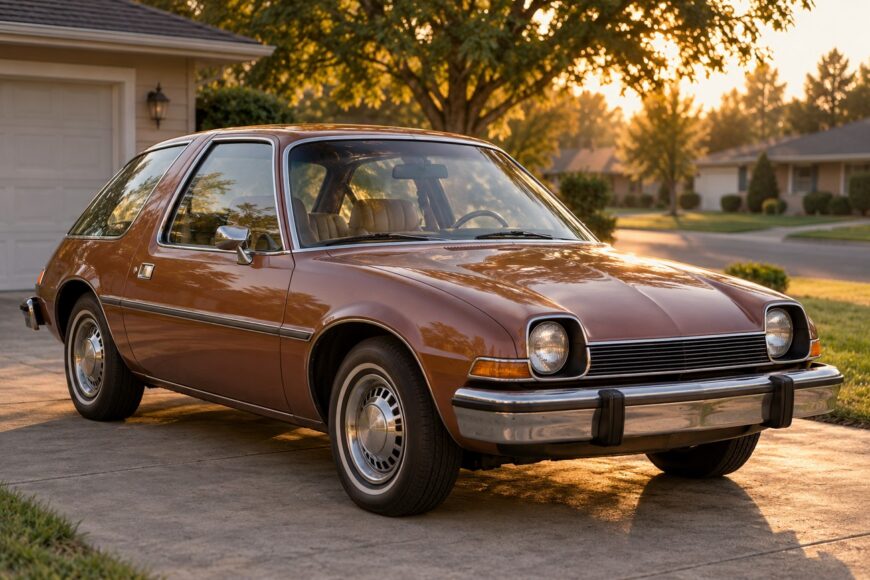
The AMC Pacer looks like a small futuristic hatchback, yet its unusual width, substantial weight, and slow performance make it feel unlike a typical compact. Its glass-heavy body promises openness and modernity; its driving experience belongs to a heavier, more traditional American car.
That contradiction explains the Pacer’s lasting appeal. Was the famous “fishbowl” design clever engineering or an impractical compromise? The answer depends on whether you value visibility and originality more than easy parking, strong acceleration, cool cabin temperatures, and readily available parts.
- What Was the AMC Pacer?
- Why the Pacer Became the “Fishbowl Car”
- Engines, Performance, and the Rotary That Never Happened
- What It Is Like to Live With a Pacer
- Why the AMC Pacer Failed in the Market
- Buying and Restoring an AMC Pacer Today
- Frequently asked questions
- What does it actually feel like to drive a fishbowl car?
- How much is an AMC Pacer worth today?
- Why was the AMC Pacer’s passenger door longer?
What Was the AMC Pacer?
The AMC Pacer was sold from 1975 through 1980 as a two-door hatchback with a front-mounted engine and rear-wheel drive. Its wheelbase measured 2,540 mm, and its overall length was approximately 4.36 m. Those figures placed it in the compact-car conversation, especially beside larger American sedans of the period.
Length, however, tells only part of the story. The Pacer’s body was approximately 1,956–1,963 mm wide, depending on the version and measurement method. That made it unusually broad for a car with such a short exterior, and the width remained one of its defining practical characteristics.
AMC developed the car around an ambitious engineering idea. The original concept was designed with a rotary engine in mind, reflecting the period’s interest in compact, smooth power units and unconventional packaging. Production realities changed the result: the Pacer reached showrooms with conventional inline-six engines.
The design therefore combined advanced packaging ideas with familiar mechanical hardware. Its rear-wheel-drive layout, broad stance, large glass area, and asymmetrical doors made it distinctive, while the heavy structure and conventional engines gave it a more traditional road character than its styling suggested.
Why the Pacer Became the “Fishbowl Car”
The nickname “fishbowl car” refers to the Pacer’s unusually large glass area. Windows extended high and wide around the cabin, giving occupants an unusually open view of surrounding traffic, curbs, and adjacent vehicles. Extensive glazing was part of the car’s visibility and safety concept, rather than a styling detail added after the engineering was complete.
The wide body helped create that effect. The Pacer was compact in length but unusually wide, so the cabin could present a broad visual field without requiring a long sedan body. The passenger-side door was longer than the driver’s door, an asymmetric feature intended to improve access to the rear seat.
That door works well as a reminder that the Pacer was carefully packaged, even when the result looks strange. A longer passenger door made rear-seat entry easier, yet it also required more room beside the car. In a narrow parking space, the same feature becomes an inconvenience because the door needs substantial clearance.
Visibility also has limits. Large windows reduce blind areas, but they expose the cabin to more sunlight, heat, and glare. Owners may find that the car feels bright and airy on a mild day, while hot traffic places greater demands on the cooling system and makes the interior tiring in direct sun.
Engines, Performance, and the Rotary That Never Happened
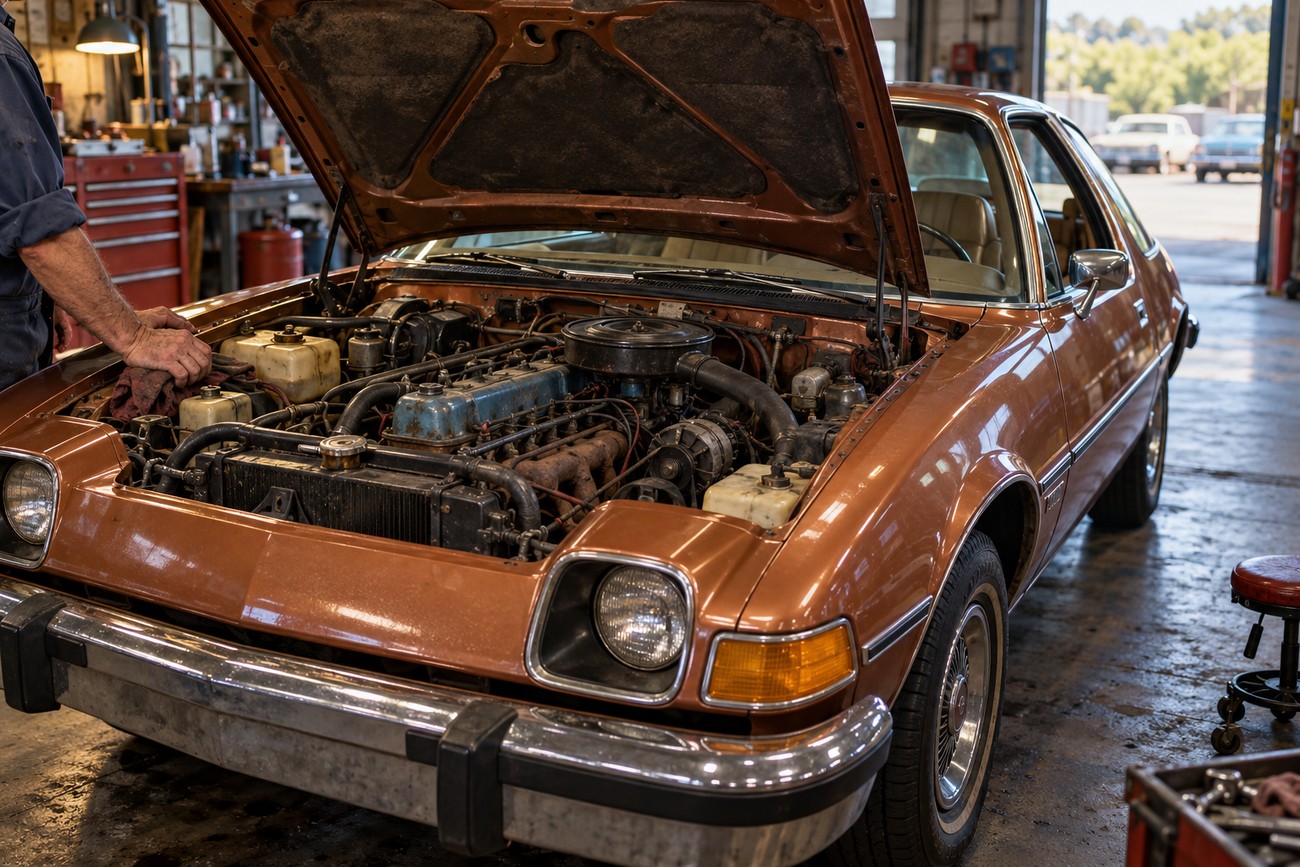
The production Pacer used 3.8-liter and 4.2-liter inline-six engines, despite the original rotary-engine ambition. The engine bay had enough room for larger hardware, which later allowed AMC to offer a V8 from 1978. That change broadened the model’s range, although it did not turn every Pacer into a performance car.
A 1975 Car and Driver test provides a useful benchmark. Its Pacer used a 258-cu-in (4,230-cm³) inline-six rated at 95 hp, a three-speed automatic, and weighed 3,432 lb, approximately 1,558 kg. The figures explain why the car’s futuristic appearance can create false expectations.
That test recorded 0–60 mph in 16.2 seconds and a quarter mile in 20.4 seconds. Car and Driver observed a maximum speed of 84 mph in that test, a result specific to the tested car and conditions. The Pacer is therefore better understood as a cruising car than as a sporty compact.
The automatic transmission, considerable mass, and modest output combine into a relaxed, sometimes laborious driving rhythm. A V8-equipped example can change the character, but buyers should identify the engine and transmission before assuming that a dramatic-looking Pacer will deliver dramatic acceleration.
What It Is Like to Live With a Pacer
Behind the wheel, the Pacer feels broad and substantial. The short length helps in some urban situations, while the width can make narrow garages, older parking spaces, and tight driveways feel closer to full-size American-car territory. The driver benefits from the excellent outward view, yet still has to judge the car’s broad sides carefully.
The long doors are another daily-use compromise. They make entry and rear-seat access easier when space is available, but they are awkward beside another vehicle or a wall. A Pacer can be perfectly manageable in an open lot and surprisingly demanding in a crowded parking garage.
Owner reports commonly mention cooling stress in hot traffic, especially on older cars. That concern deserves a mechanical inspection rather than a blanket assumption: radiator condition, fan operation, hoses, and the general health of the cooling system matter greatly. Extensive glazing can also raise cabin heat and glare, increasing the importance of effective climate control.
There are worthwhile chassis strengths. Front disc brakes and rack-and-pinion steering were notable features for the class, giving the Pacer a sound foundation for ordinary cruising. They do not erase the slow acceleration or wide footprint, but they help explain why a well-maintained example can remain usable rather than merely displayable.
Why the AMC Pacer Failed in the Market
The Pacer’s market problem was a mismatch between visual promise and everyday expectations. Its compact length suggested an easy, economical small car, while its 1,956–1,963-mm width, substantial mass, and American mechanical layout produced a different experience. Buyers who expected the footprint of a truly small hatchback could be surprised by its bulk.
The rotary engine concept also shaped expectations that production could not fulfill. The final car used inline-six engines, and the weight of the vehicle worked against brisk acceleration and fuel economy. With an automatic transmission, the effect became more pronounced in ordinary traffic and on hills.
Styling created another problem. The Pacer looked futuristic enough to suggest speed, advanced technology, or both. The 1975 test results told a calmer story: 0–60 mph in 16.2 seconds, a quarter mile in 20.4 seconds, and an observed maximum speed of 84 mph. Its design was memorable; its performance was deliberately modest.
That does not reduce the car to a failed experiment. The Pacer tried to solve packaging, visibility, access, and safety concerns in an unusual way. Its commercial difficulty came from asking buyers to accept several compromises at once, including width, weight, heat, limited performance, and unfamiliar proportions.
Buying and Restoring an AMC Pacer Today
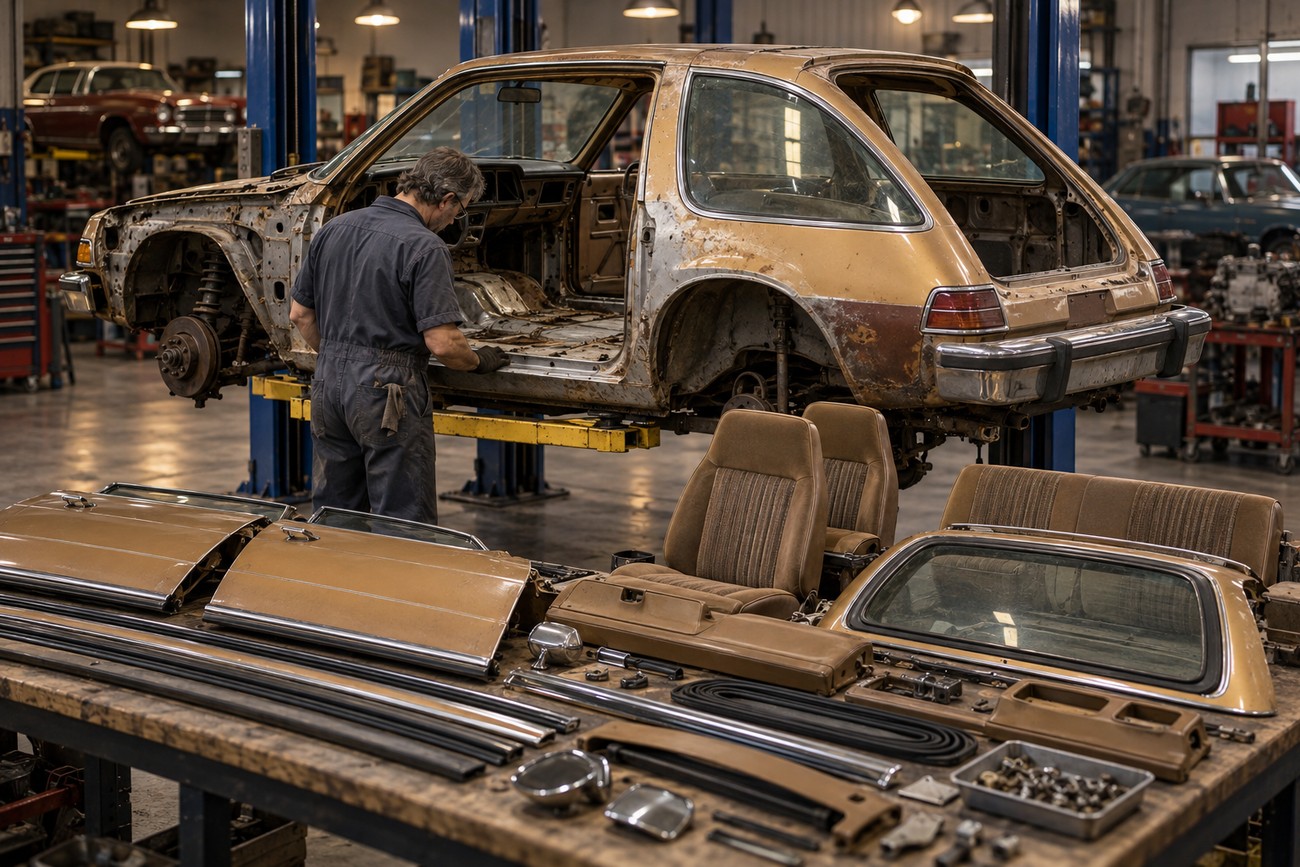
A Pacer should be bought as a specialized classic, rather than as a cheap economy car. Begin with the body, because rust repair and missing panels can overwhelm the value of an apparently inexpensive project. Check the floors, structural areas, door openings, hatch surrounds, and the condition of the unusual glass.
Completeness matters just as much as visible paint. Specific body panels, glass, interior trim, and other Pacer parts can be difficult to source. A car with worn cosmetics but its correct doors, windows, moldings, seats, and hardware may be a better starting point than a shiny shell missing rare pieces.
Mechanical work comes after that assessment. Confirm the engine specification, transmission, cooling-system health, brakes, and steering, then identify whether the car is an early model, a D/L trim, or a V8-equipped version. Different years and specifications should not be treated as interchangeable.
Correct specification and completeness can matter more to collectors than cosmetic perfection alone. Before purchase, measure the garage and parking space as carefully as the car: approximately 1,956–1,963 mm of body width can turn an apparently suitable storage space into a daily frustration. The same check should include room for the long doors to open.
Frequently asked questions
What does it actually feel like to drive a fishbowl car?
A Pacer feels unusually exposed and visually open from inside. The high glass area gives a broad view of traffic and surroundings, while the wide body makes the cabin seem spacious in the lateral direction. Sunlight and reflections are also more present than in a conventional car, so the experience can shift from airy to hot and tiring on a bright day.
Its road manners are calmer than its styling suggests. Acceleration is slow in many examples, and the car’s width remains noticeable in tight spaces. The best setting is relaxed cruising, where the visibility and distinctive seating position matter more than quick responses.
How much is an AMC Pacer worth today?
There is no single useful value for every Pacer. Condition, year, trim, engine, V8 availability, completeness, documentation, and the presence of correct glass and interior parts all influence what a car is worth to a buyer.
A complete, correctly specified car may be more desirable than a cosmetically attractive project with missing Pacer-specific components. Inspect the body and parts supply before judging the price, because restoration difficulty can matter more than surface appearance.
Why was the AMC Pacer’s passenger door longer?
The passenger door was longer to improve access to the rear seat. Its extra length helped passengers enter and exit through the two-door body without requiring a separate rear door.
The design has a practical limitation: the door needs more side clearance. It is helpful in an open driveway and inconvenient beside another vehicle, which neatly captures the Pacer’s wider character—clever packaging with real ownership compromises.







