
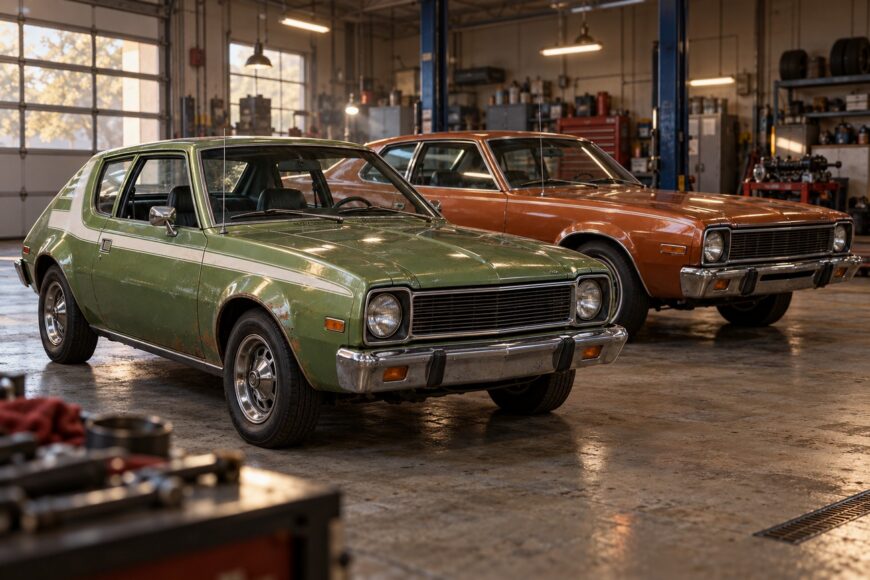
“The AMC Gremlin was simply a Hornet cut short” is the familiar accusation. It contains a useful mechanical truth: AMC based the car on the Hornet, reusing its architecture and much of its running gear. It misses the more interesting part of the story, however. The Gremlin’s shortened rear body, hatch, glass, side panels, and visual treatment required substantial new design work.
That makes the Gremlin both an exercise in engineering economy and a genuinely distinctive compact. Its clever packaging came with predictable compromises: rust-prone structure, limited rear space, early four-wheel drum brakes, and restoration costs driven by scarce body and trim parts. The result is easier to understand as a clever derivative than as either a crude chop or a pure design masterpiece.
- What the AMC Gremlin Actually Borrowed from the Hornet
- A Kammback That Was More Than an Editorial Shortcut
- Where the Clever Idea Meets Its Compromises
- Buying and Restoring One Without Being Fooled
- Frequently asked questions
- When was the AMC Gremlin first introduced?
- How should you drive an early Gremlin with an unsynchronized first gear?
What the AMC Gremlin Actually Borrowed from the Hornet
The Gremlin was based on the AMC Hornet, and the relationship is obvious beneath the skin. AMC reduced the wheelbase from 108 to 96 inches (2743 to 2438 mm), while approximate overall length fell from 179 to 161 inches. The front structure and much of the mechanical package remained closely related to the larger car.
Its basic layout was conventional: a front engine, rear-wheel drive, a solid rear axle, and leaf springs. This gave AMC a compact car without the expense of creating a wholly new platform. The rear half, however, was substantially reworked around the shortened body, hatch, and abrupt Kammback tail.
Early Gremlins used inline-six engines, four-wheel drum brakes, and a three-speed manual transmission with an unsynchronized first gear. Those details place the car firmly in its period. A buyer expecting modern braking behavior or effortless transmission operation can misread normal design characteristics as faults.
U. S. production ran from 1970 to 1978, with 671,475 cars built. Mexican production continued to 1983, and market differences matter when identifying a surviving example. The platform connection makes mechanical repairs more manageable; it does not turn every Gremlin body part into a Hornet replacement.
A Kammback That Was More Than an Editorial Shortcut
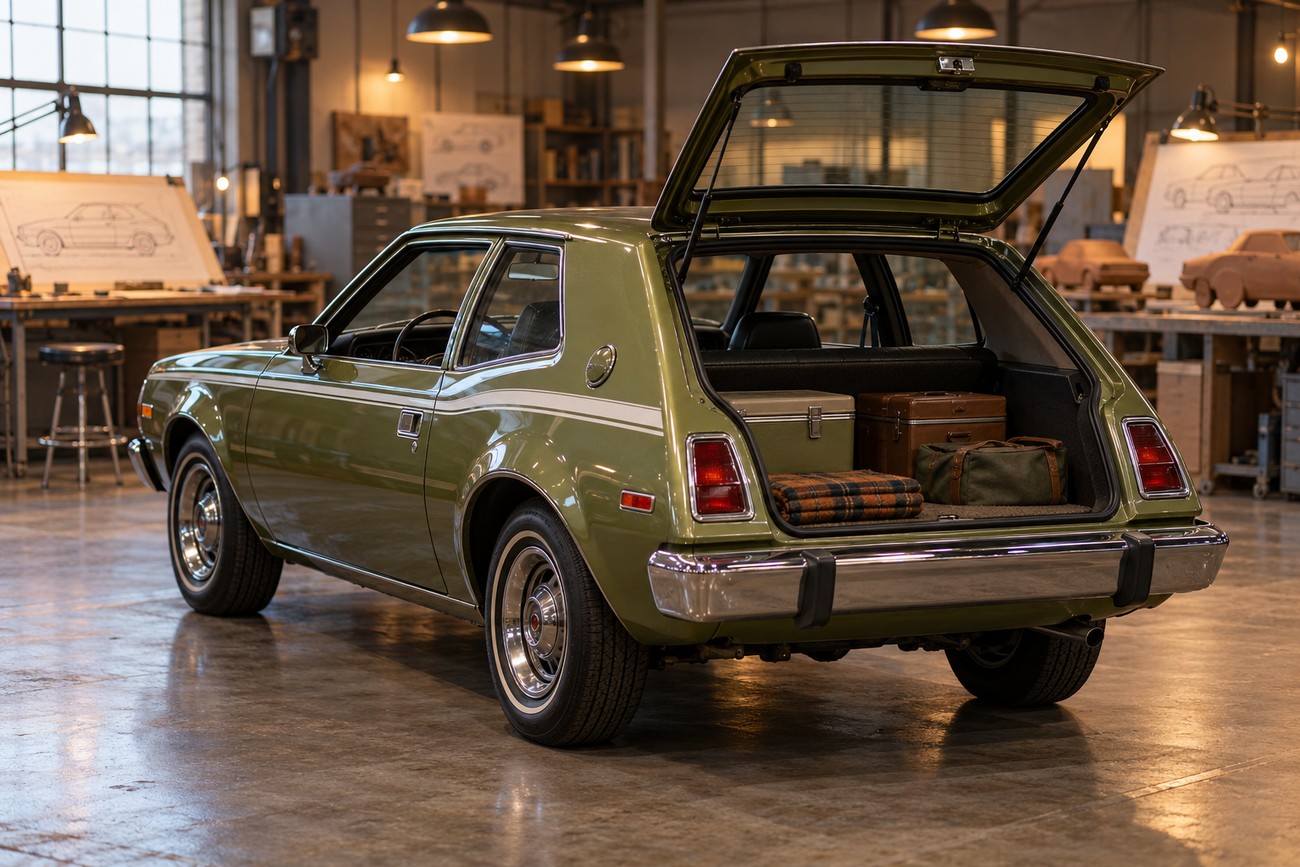
The Gremlin’s rear was a deliberate compact-car solution. The vertical Kammback ending reduced length while preserving a useful rear hatch and gave the car a silhouette that could be recognized from a distance. Its proportions were unusual because the design had to solve a packaging problem, rather than merely imitate a conventional fastback.
Dick Teague, Bob Nixon, and their studios contributed to the design. The rear body, side panels, glass, hatch, and related interior details were developed around the shortened car. The familiar story about an idea sketched on a package associated with motion sickness is part of the Gremlin legend, not a complete account of the production design process.
Stylistically, the Gremlin therefore earned an identity of its own. Structurally, it remained an economical derivative of the Hornet, with inherited engineering and a conventional rear-drive chassis. That tension is the fairest answer to the title: the car was financially rational underneath and visually inventive at the back.
Where the Clever Idea Meets Its Compromises
Early four-wheel drum brakes demand careful adjustment and inspection, especially if the car is driven in traffic or on long descents. They can lose effectiveness as heat builds, so a complete brake overhaul matters more than the apparent mileage of a project car.
The early three-speed manual also requires a different technique. Its unsynchronized first gear may need double-clutching and matching engine speed, particularly when selecting it while moving. A driver unfamiliar with that arrangement may blame the gearbox for behavior that is normal for the specification.
The 96-inch wheelbase helped create the Gremlin’s compact proportions, but it also made the ride firm and sometimes nervous on poor roads. Leaf springs and a solid rear axle are durable and simple, yet the short car can react sharply to broken pavement. Rear-seat space is limited compared with the Hornet, which is the practical price of the shortened body.
Later offerings included a 3.3-liter inline-six, the 4.2-liter 258 inline-six, and the 304 V8, with manual and automatic transmissions varying by year and market. X versions encouraged a sportier image, but the underlying chassis remained economical. A solid rear axle, leaf springs, and drum-brake versions tell you more about the car’s real priorities than the trim badge does.
Buying and Restoring One Without Being Fooled
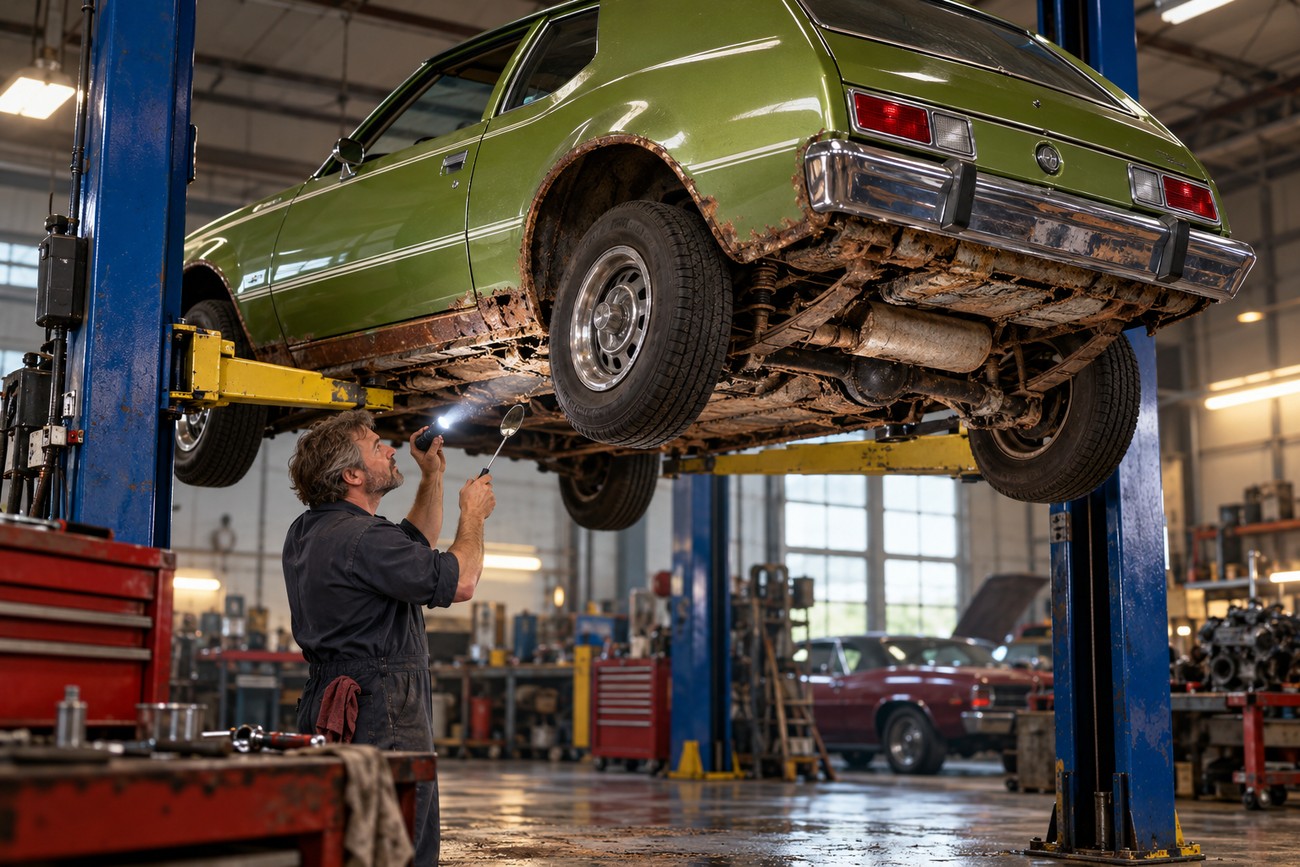
Start underneath, regardless of how bright the paint looks. Check the floors, rockers, wheel arches, frame rails, spring mounts, and the metal around the windshield and other glass. Rust in these areas can turn a seemingly complete car into a major body project.
The individual car’s condition matters more than the Gremlin’s reputation. A sound shell with a tired engine can be a sensible starting point because common AMC mechanical components are generally easier to replace or adapt. A shiny car with repaired structural corrosion may conceal expensive work.
Original trim and interior parts can decide whether a restoration remains realistic. Engines and chassis components are usually easier to source than Gremlin-specific glass, emblems, seats, and body pieces.
Inspect the hatch, glass, moldings, emblems, seats, and interior fittings before committing to a “nearly complete” project. Hornet mechanical commonality does not make the unique Gremlin rear body interchangeable. Rare V8 cars may attract more attention, while cooling, maintenance, and missing specific parts can raise the cost of completing one.
Verify the model year, engine, transmission, equipment, and market origin. Mexican VAM versions and later-market cars can differ substantially from U. S.-market examples. The best restoration candidate is usually the most complete and least corroded car, rather than the cheapest one or the car with the most ambitious engine.
Frequently asked questions
The Gremlin’s history becomes clearer when its launch context and operating details are separated from later enthusiast mythology.
When was the AMC Gremlin first introduced?
The AMC Gremlin was introduced on April 1, 1970. It arrived during an early wave of American responses to imported compact cars and preceded the market reaction represented by the Chevrolet Vega and Ford Pinto. Its compact rear-drive format gave AMC a quick entry without the cost of an entirely new platform.
How should you drive an early Gremlin with an unsynchronized first gear?
Use double-clutching and match engine speed before selecting first gear while the car is moving. Press the clutch, shift to neutral, release and reapply the clutch while bringing the engine speed to the level needed for first gear, then engage it smoothly. Selecting first at a standstill is simpler, while forcing the lever can accelerate wear.







