
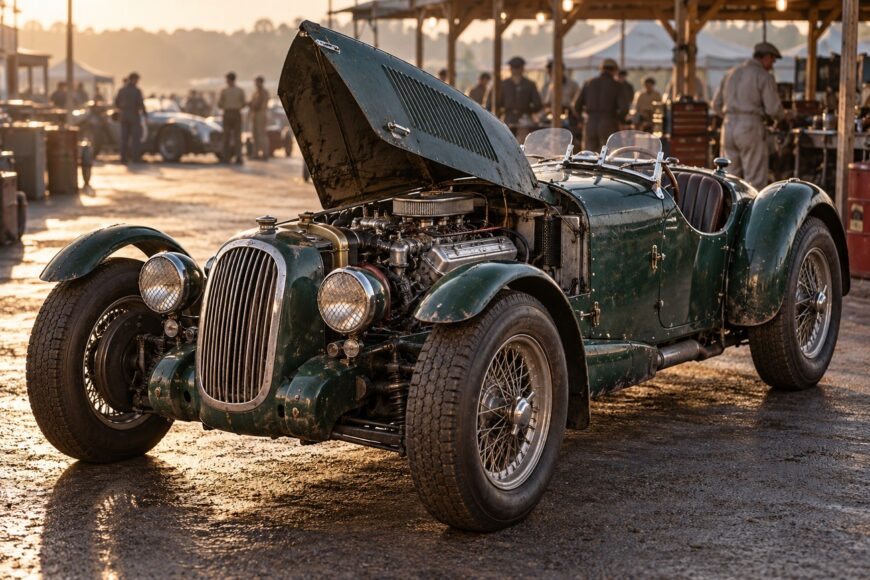
A light British racer with a Cadillac V8 under its long hood had an obvious appeal: abundant torque in a car built for competition. The Allard J2 could accelerate hard out of a corner, yet its speed came with the demands of a period chassis. Steering inputs, tire choice, and braking technique mattered as much as horsepower.
That combination earned the J2 a place in early-1950s racing, particularly in the in the assessment of specialists active in the field. For an owner today, the same mechanical simplicity can be deceptive. Understanding how a particular car was built, raced, and repaired is essential to preserving both its character and its ability to be driven safely.
- Why the Allard J2 became a Cadillac-powered racer
- The 331 Cadillac V8 and the chassis beneath it
- What the J2 proved in early-1950s racing
- Where the speed outran the brakes and handling
- Why a Cadillac-powered J2 is hard to authenticate
- The restoration checks that matter before buying
- Frequently asked questions
- What is the average price of a 1952 Allard J2X?
- What does “matching numbers” mean if a J2 was delivered without an engine?
- What should an owner confirm before entering a J2 in a historic event?
Why the Allard J2 became a Cadillac-powered racer
Produced from 1949 to 1951, the Allard J2 was rare even by the standards of postwar competition cars. Estimates place production at approximately 90–100 cars, with totals differing between registers. That uncertainty is worth retaining: a surviving J2 is best understood through its individual record, rather than a supposedly definitive production figure.
The underlying idea was direct. Allard supplied a light British sports-racing chassis that could take a large American V8, giving entrants strong acceleration without the mass of a larger car. The Cadillac engine became closely associated with the J2 because it suited that purpose, especially for competitors in the United States.
It is misleading, however, to describe every J2 as factory-fitted with a Cadillac. Some cars were supplied without engines for installation in the United States, and Chrysler and Oldsmobile V8 installations also existed. The engine in a car today may reflect its first racing configuration, a later period change, or a much more recent decision; those histories have different meanings to a buyer or restorer.
The 331 Cadillac V8 and the chassis beneath it
The Cadillac V8 commonly associated with the J2 displaced 331 cu in (5.4 liters). In standard form, it produced approximately 160–190 hp, while race-prepared examples could exceed 250 hp. Those figures describe different states of tune, not a specification shared by every Cadillac-powered J2.
A racing-specification J2 with an American V8 weighed approximately 950–1,050 kg, though individual cars varied. Even a relatively modestly tuned engine could therefore give the car forceful acceleration. Extra race-prepared power raised the stakes for the rest of the machine: the driver still had to put it through narrow tires and slow it with period brakes.
Under the body sat a ladder frame, independent front suspension with a transverse leaf spring, and a live rear axle with longitudinal leaf springs. This was a workable late-1940s layout, rather than a chassis designed around the grip and repeated braking loads expected of a modern race car. Its behavior depends heavily on alignment, spring condition, tires, and the details of a particular engine installation.
The specification sheet also hides differences between surviving cars. Engine placement, ancillary equipment, and decades of repairs can change weight distribution and access beneath the hood. Inspecting the actual car tells a prospective owner more than assuming that every J2 with a Cadillac badge will feel alike.
What the J2 proved in early-1950s racing
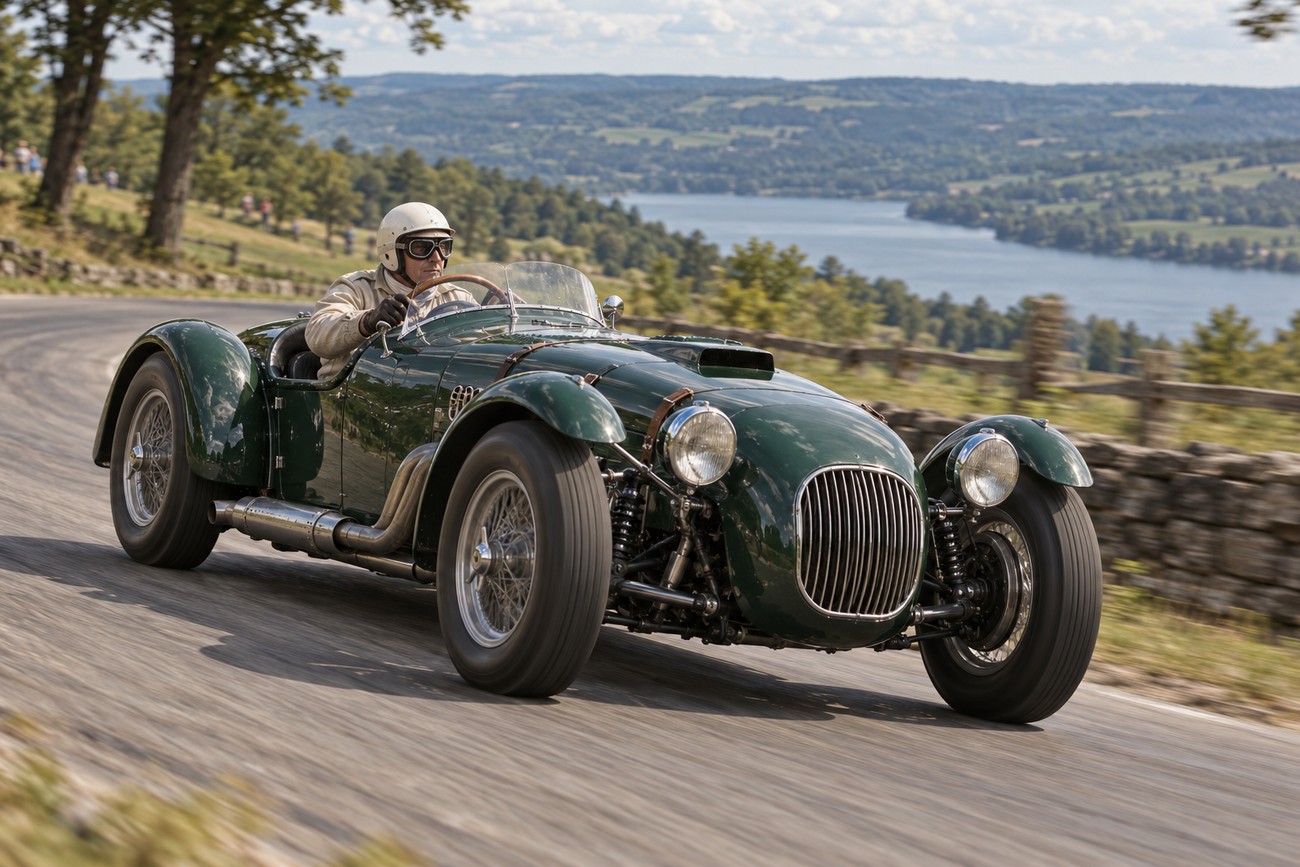
Cadillac-powered J2s appeared in SCCA and international competition in the early 1950s. Racing at Pebble Beach and Watkins Glen forms part of that history, alongside use by American entrants and the Allard team. Those settings show where the combination was tested without turning every period appearance into an unsupported claim of victory.
The car’s advantage was clearest when power mattered. With a racing-specification weight of approximately 950–1,050 kg and a suitably prepared V8, a J2 could gain speed quickly on a straight or out of a bend. Output varied with the engine build, so its competitiveness cannot be reduced to one horsepower figure.
Period racing also rewarded crews able to prepare a car for a particular course. Cooling, gearing, brake condition, and tire setup could decide whether the engine’s acceleration remained useful over a race distance. A J2 that was effective in its own era was not thereby equipped for sustained modern track use without inspection and preparation.
That distinction matters when reading a car’s competition history. Old photographs or entry records may establish where it ran, but they do not establish that its present engine, brakes, or chassis setup matches what was used then. The racing record and the machine now offered for sale need to be examined separately.
Where the speed outran the brakes and handling
The J2 generally used large-diameter, unassisted drum brakes. They could do their job in period use, but repeated hard stops can bring fade, and the pedal asks more of the driver than a modern assisted system. A powerful engine can make it easier to arrive at the next corner faster than those brakes can comfortably manage.
Heat is another practical limit. A Cadillac V8 occupies a tight engine bay, and cars used hard on a track or in hot conditions can overheat without adequate cooling preparation. Before increasing engine output, an owner should establish that the radiator, airflow, hoses, and cooling system can cope with the intended use.
The chassis rewards attention and can punish abrupt inputs. High torque, a live rear axle, and an unsuitable tire or suspension setup can make oversteer more difficult to catch. Wide modern tires are no automatic cure: changing grip without considering period geometry may make breakaway less predictable or expose weaknesses elsewhere.
Calling the J2 a ready-made modern track car overlooks these linked limits. Brakes, cooling, handling, and safety equipment need assessment together, under the rules of the event in question. Its immediacy is part of the appeal, but the driver must leave a margin that a contemporary performance car might conceal.
Why a Cadillac-powered J2 is hard to authenticate
A Cadillac V8 alone cannot establish how a J2 left Allard or how it first competed. Some cars were supplied without engines for installation in the United States, while others used different American V8s. A documented period Cadillac installation can be an important part of a car’s identity without requiring a claim that every authentic J2 had a factory-fitted Cadillac.
The stronger starting point is chassis identity. Compare identifying details with registers, period photographs, entry records, and the history of successive owners where available. Then trace the engine separately: a later Cadillac block can keep the car usable while differing substantially from its documented early configuration.
Records are often incomplete, and racing cars were altered to remain competitive or repair damage. A change made during the car’s active period deserves a different description from a recent swap, even if both result in a Cadillac-powered J2 today. Honest documentation makes those distinctions clearer than a blanket claim of originality.
A further question is whether the vehicle is a documented surviving J2 or a later assembly from parts. The two can look similar after restoration, particularly when body panels have been remade. Establishing a continuous history helps an owner understand what is being preserved and helps a buyer assess claims that appearance alone cannot verify.
The restoration checks that matter before buying
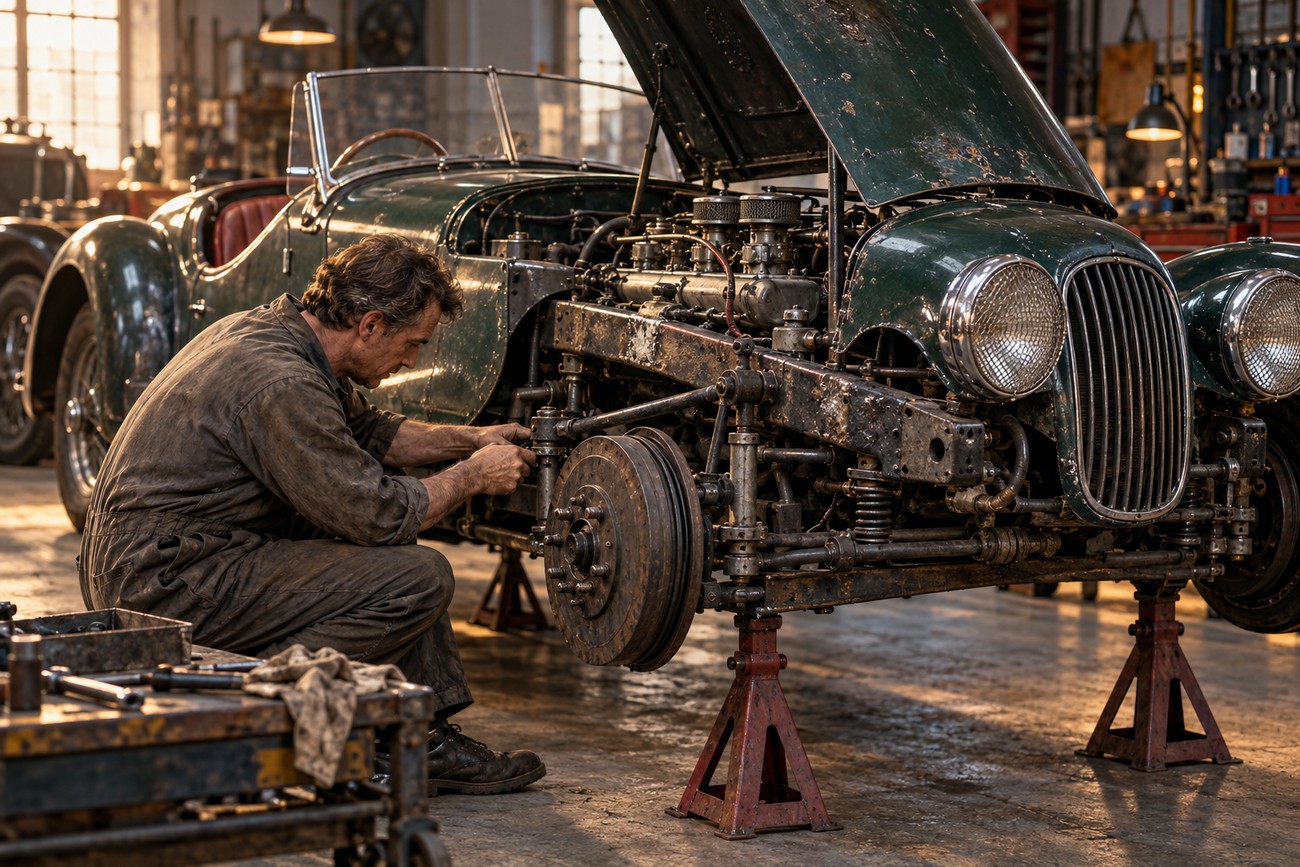
Begin with the frame and body, especially on a car with a competition past. Fatigue cracks and old repairs may sit beneath paint or neatly finished panels, so a polished exterior is no substitute for close inspection of stressed areas and joints. The condition of the underlying structure should shape the restoration plan before cosmetic work does.
Suspension and steering components deserve equally careful examination. Original parts can be scarce, and accurate replacements may require fabrication rather than an order from a catalog. Check the quality of previous repairs as well as the condition of what remains; a tidy-looking assembly can still have incorrect dimensions.
Check suspension geometry against club drawings and measurements from original cars before fitting replacement body panels or wider tires. A visually tidy rebuild can still handle badly if its underlying dimensions have drifted.
Budget for brakes and cooling as connected systems, particularly if the car will be driven hard. An ambitious engine tune can increase heat and mechanical strain before the rest of the car is ready for it. Likewise, a tire change should follow a review of alignment, steering clearance, and suspension condition rather than serve as a shortcut to more grip.
Period-correct trim, engine fittings, and hand-shaped panels can also turn an optimistic estimate into a demanding project. For road use, inspect the lights, wiring, seat mounts, and other safety-related details alongside local registration requirements. The sensible purchase is the car whose structure, work history, and intended use can be reconciled before restoration begins.
Frequently asked questions
The J2’s name covers cars with varied engine and racing histories, so questions about value, originality, and event entry need car-specific answers. The distinctions below are useful starting points for checking a listing or preparing to drive one.
What is the average price of a 1952 Allard J2X?
There is no defensible average here without a dated set of comparable, completed sales. A 1952 J2X is a different model from the J2 produced from 1949 to 1951, so J2 transactions should not be mixed into a J2X estimate. Compare realized prices, rather than asking prices, for cars with similar identity, documentation, condition, and mechanical specification. Record the sale date and any disclosed restoration needs before drawing a conclusion.
What does “matching numbers” mean if a J2 was delivered without an engine?
It cannot automatically mean that the car retains a factory-fitted Cadillac engine. If a J2 was supplied without an engine, the useful evidence is its chassis identity and documentation showing when and where the engine was installed. Ask which numbers can be linked to period records, and describe any replacement block separately. A documented early installation and a later engine of the same type should not be presented as identical histories.
What should an owner confirm before entering a J2 in a historic event?
Ask the organizer for the event’s current safety-equipment requirements, technical inspection criteria, and eligibility documentation. Confirm whether the car’s present engine, tires, and other modifications suit the category entered, then check what insurance is required and what it covers. Rules differ between events; a previous entry or a period racing record does not guarantee admission. Inspect brakes, cooling, steering, and seat mounts for the demands of the planned use before arriving at scrutineering.







