
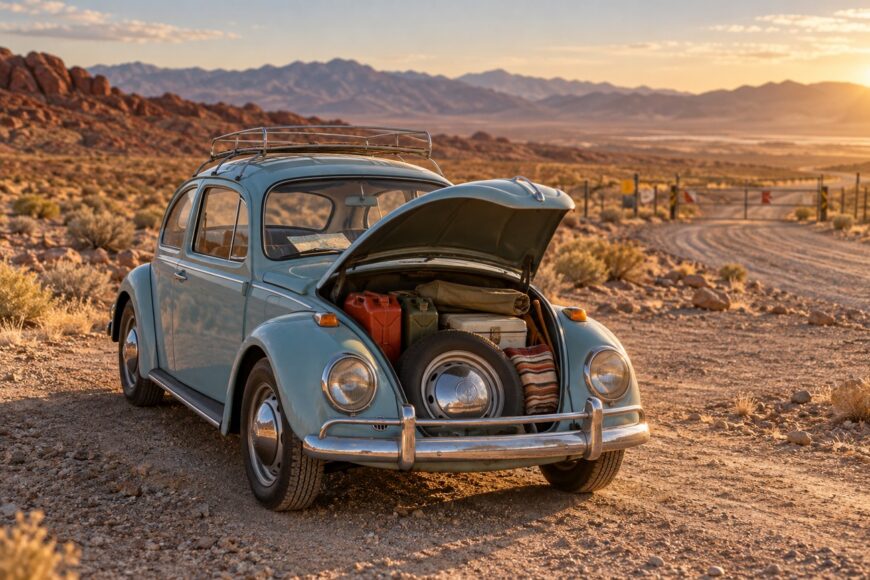
The classic VW Beetle arrives in Nevada with a cheerful air-cooled engine, narrow tires, and a reputation for surviving almost anything. The desert has a different opinion. Heat, long high-speed runs, rough access roads, and delayed assistance can turn a small fault into a serious roadside problem long before the car reaches its planned photo stop.
Area 51 adds a legal limit to the mechanical one. The installation sits inside the Nevada Test and Training Range, is closed to the public, and has no ordinary entrance or tour. A sensible trip prepares the specific Beetle, carries enough water and recovery equipment, and ends at a legal public-access point. Chasing the fence line can turn a quirky road trip into a heat, mechanical, or trespass emergency.
- The Road Trip Ends Before Area 51
- Can a Classic Beetle Handle Nevada?
- Make the Beetle Road-Trip Ready
- Heat, Water, and the Small Failure That Becomes an Emergency
- Choose the Legal Route, Not the Fence Line
- What Beetle Owners Get Right—and Wrong
- Frequently asked questions
- How close can you drive to Area 51?
- What is the black mailbox in Nevada?
- What should I do if my Beetle breaks down where there is no phone signal?
The Road Trip Ends Before Area 51
Area 51 is a restricted military site, not a conventional roadside attraction. The base is inside the Nevada Test and Training Range, and public visitors cannot drive in for a closer look. There is no visitor center, public gate, or ordinary tour waiting at the end of the road.
The nearest publicly accessible point is more than 15 miles from the site. That distance matters because the visible landscape can make the destination feel closer than it is, while fuel, shade, cellular coverage, and roadside help remain limited. Plan the route around the legal endpoint rather than treating it as a failure to reach the “real” attraction.
Warning signs, orange boundary markers, and posted restrictions define where a road trip must stop. Do not cross them, move around them, or assume an empty road grants permission. Unauthorized entry can constitute unlawful trespass or another violation; claims about guaranteed arrest or a specific fine require an official legal source and should not be treated as travel advice.
The rewarding part of this trip is the approach, the desert scenery, and the unusual history surrounding the area. A photograph taken from a lawful public location is a successful outcome. A Beetle parked safely in the shade of a permitted stopping area is a better souvenir than a car abandoned near a restricted boundary.
Can a Classic Beetle Handle Nevada?
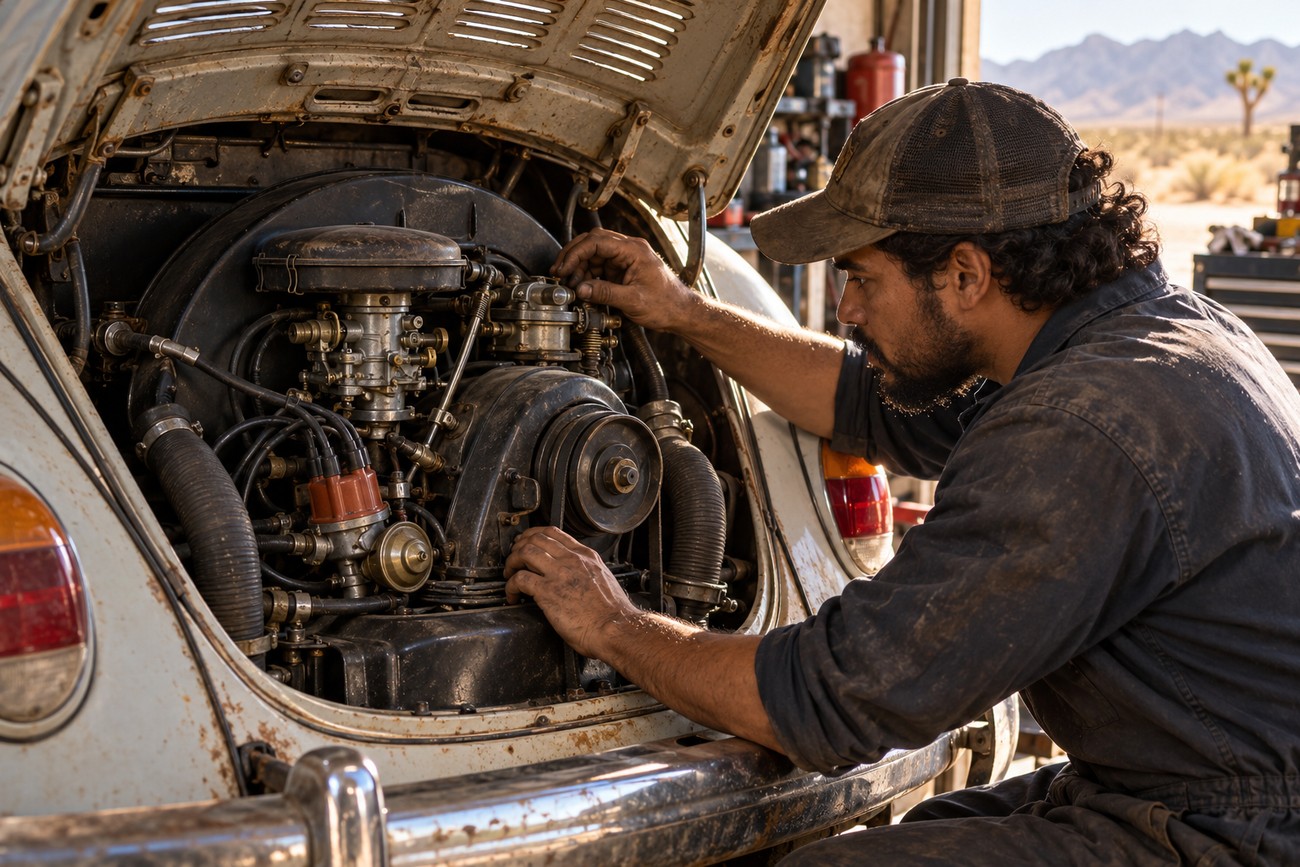
A well-sorted classic Beetle can complete a long journey, including difficult desert mileage. Its air-cooled engine has fewer liquid-cooling components, yet that simplicity does not make it immune to heat. Reliability depends on the actual engine, the quality of previous repairs, and the condition of every cooling and fuel-system component.
Factory cooling tin, hoses, the thermostat, and seals are functional cooling components, not decorative parts. Missing pieces can disturb airflow or allow hot air to recirculate around the engine. A Beetle that seems fine on a short local drive may show its weakness during a sustained climb or a hot highway run.
Long-distance confidence should come from the condition of the car in front of you, rather than from the model’s reputation. A classic that has been maintained carefully can travel far; an attractive car with missing cooling parts can fail quickly.
Some owners report 5,000–15,000-mile trips without major trouble, while modern cars are generally more reliable and age-related failures remain more likely in classics. Those statements can coexist. The relevant comparison is a tested, maintained Beetle against a modern vehicle, not a legend against a specification sheet.
Keep the model distinction clear during research. A classic air-cooled Beetle is not the same vehicle as a New Beetle or modern Beetle. Reviews of later cars, including their cooling, comfort, and highway behavior, cannot validate a vintage car’s readiness for an isolated Nevada route.
Make the Beetle Road-Trip Ready
Begin with the systems that can stop the car or endanger its occupants: brakes, steering, wheel bearings, tires, and suspension. Inspect brake lines, hoses, fluid condition, and pedal feel, then check for play or noise in the steering and hubs. A transmission that shifts acceptably in town still deserves inspection before it must handle heat, grades, and remote recovery.
Age deserves the same attention as mileage. Original rubber, wiring, fuel hoses, brake lines, and seals may look serviceable while becoming brittle. Replace questionable fuel hose before a hot trip, secure wiring away from heat and movement, and inspect for leaks around the engine, gearbox, and wheel hubs.
Service the engine according to its needs rather than the optimistic wording of a sales listing. Older Beetles need regular valve adjustment and frequent oil changes, and many older engines lack a full-flow oil filter. Check ignition components, timing, plugs, and charging performance, since a small fault in any of these areas can become difficult to diagnose beside an empty desert road.
A short proving drive can hide the failures that appear only after full warm-up. Several repeated two-hour runs with climbs, highway running, and sustained heat expose valve, cooling, ignition, braking, and bearing problems before the car reaches a remote route.
Do not trust a recent purchase immediately. Drive the Beetle for several weeks in ordinary traffic, record oil use and temperatures, and correct faults as they appear. Then repeat longer tests with a complete warm-up, sustained running, climbs, and an inspection afterward; a “road-trip ready” claim is no substitute for evidence from the specific car.
Finish by checking the complete factory cooling system. Confirm that the cooling tin, hoses, thermostat, seals, and engine compartment barriers are present and correctly fitted. Removing factory parts may appear to simplify access, yet it can reduce cooling performance or conceal the cause of an overheating complaint.
Heat, Water, and the Small Failure That Becomes an Emergency
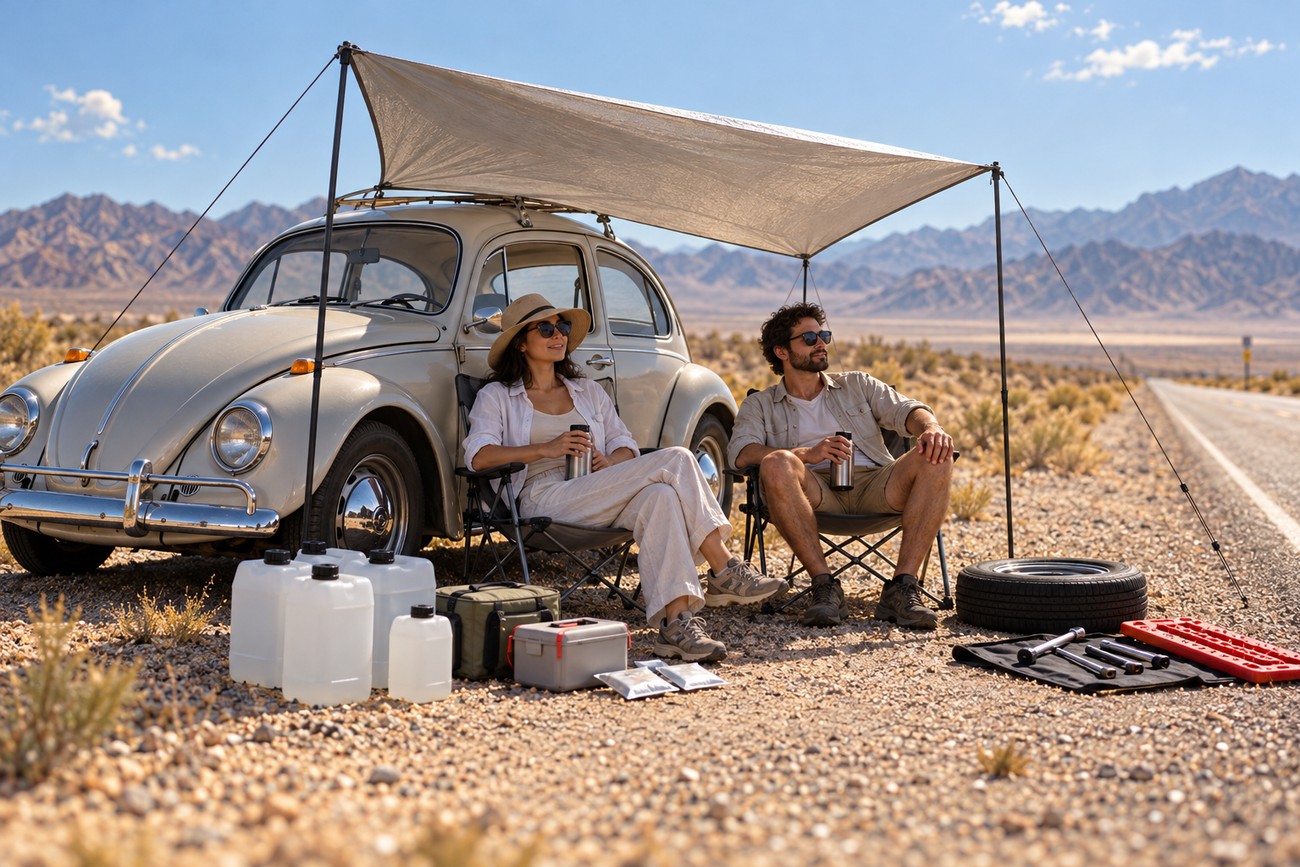
Nevada heat changes the meaning of a breakdown. Without air conditioning or reliable shade, occupants can become dehydrated or overheated while waiting for help, especially after a failure that seems minor. A stalled engine is inconvenient in town; on an isolated road, it can become a medical emergency.
The Nevada Red Cross recommends at least 1 gallon of water per person in extreme heat. Treat that as a baseline for the people in the car, with the plan allowing for waiting for recovery rather than covering only the drive. Carry electrolytes, a first-aid kit, a practical shade source, and sun protection, including clothing and sunscreen or a shade screen for the vehicle.
Tell someone the route, the intended stopping point, and the expected return time. Arrange recovery before leaving and identify where a tow or support vehicle could reach you. Cellular coverage may be weak, so a phone alone is not a complete communication plan.
Water also supports sensible roadside decisions. It gives occupants time to stay with the vehicle, create shade, and wait for organized assistance instead of walking into unknown heat. A spare belt, tools, and basic fluids may help with a repair, but they do not replace water, shade, and a recovery plan.
Choose the Legal Route, Not the Fence Line
National Park Service guidance for desert dirt roads favors four-wheel drive, high clearance, and off-road tires. A standard classic Beetle usually does not meet those recommendations. Its rear-engine traction can help on some surfaces, yet limited clearance, road tires, age-related suspension parts, and a low body leave little margin on rough approaches.
Choose the least demanding legal route that reaches the planned public endpoint. Check the surface, weather, fuel options, and turnaround space before committing. Remote roads around the range are not automatically tourist roads, and a route that looks passable in a photograph may be punishing after washboard, loose gravel, or heat has affected the car.
Follow every warning sign, orange boundary marker, and posted restriction. Never improvise around a closed road or treat a gap in a fence as an invitation. The route ends where public access ends, even if the restricted installation remains visible in the distance.
Weak coverage, limited fuel, and limited roadside assistance make route discipline part of vehicle safety. Leave enough fuel to turn around, keep the car within its tested limits, and avoid a schedule that pressures you to continue after temperatures, brakes, or weather become concerning. The best endpoint is one you can leave under your own control.
What Beetle Owners Get Right—and Wrong
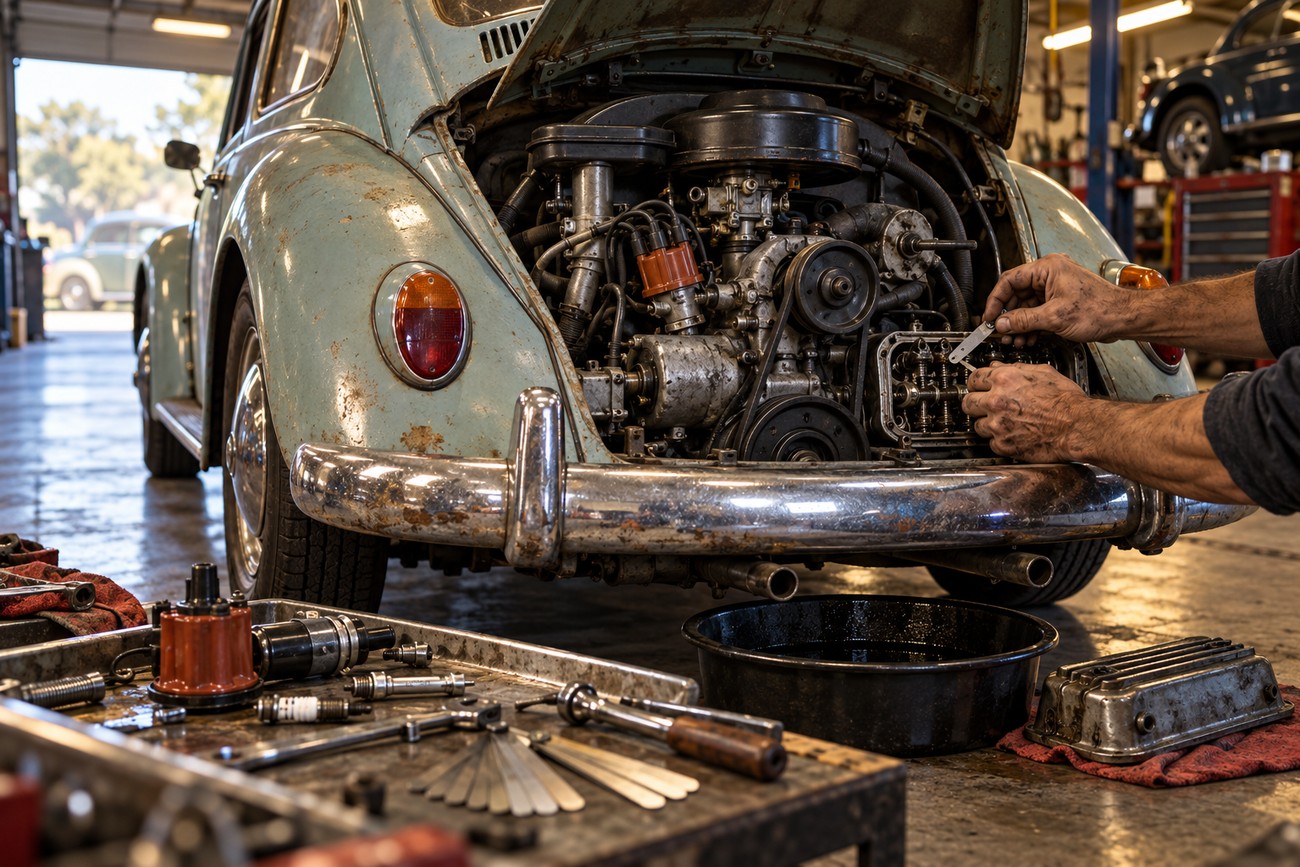
Owners are right that a healthy Beetle can be remarkably capable. They are also right that it demands more attention than a modern vehicle. Regular valve adjustment, frequent oil changes, ignition checks, and inspections are part of ownership, especially when the car will spend hours at speed in hot weather.
Highway oil-temperature concerns at 65–70 mph in hot climates deserve respect. That does not prove every Beetle will overheat at those speeds, nor does a normal short drive prove that yours will remain cool. Load, tune, engine condition, airflow, ambient temperature, and the completeness of the cooling system all affect the result.
The claim that a Beetle can never overheat is false. Missing cooling tin, hoses, a thermostat, or seals can increase risk, while previous owners may have removed parts for convenience or misunderstood their purpose. A familiar model name cannot compensate for an engine with age-related defects.
The practical conclusion is conditional. A carefully inspected and repeatedly tested classic may be an enjoyable long-distance car, while a modern car is generally more reliable for remote travel. The Beetle’s strong reputation should encourage proper preparation, not replace it.
Frequently asked questions
These answers separate the public travel experience from the restricted installation and focus on decisions that matter once the road becomes remote.
How close can you drive to Area 51?
You can drive to a legal public-access point more than 15 miles from the site, but you cannot drive to a public entrance because the base is closed to the public and has no ordinary public tour. Treat the permitted endpoint as the destination, then return by the marked route.
Distance on a map can be misleading in open desert. Use posted signs and boundary markers as the controlling information, and do not turn a viewpoint or roadside landmark into an attempt to approach the installation.
What is the black mailbox in Nevada?
The black mailbox is a roadside landmark associated with travelers visiting the Area 51 region. It is not an official entrance, checkpoint, visitor center, or permission to approach the base.
Use landmarks like this only as navigation references within a lawful route. Stop where parking and access are permitted, avoid trespassing on surrounding property, and continue to respect all military-area warnings and boundary markers.
What should I do if my Beetle breaks down where there is no phone signal?
Stay with the vehicle unless remaining there creates an immediate danger. Create shade, conserve water, use electrolytes carefully, and make the car visible from the route. Avoid an impulsive long walk because distance, heat, and uncertain coverage can turn a manageable wait into a life-threatening situation.
Follow the recovery plan arranged before departure: use any available communication method, wait for the designated contact, and give clear location details when a signal returns. Keep occupants together, monitor for heat illness, and treat water as a resource for the entire delay, not only for the original drive.







