
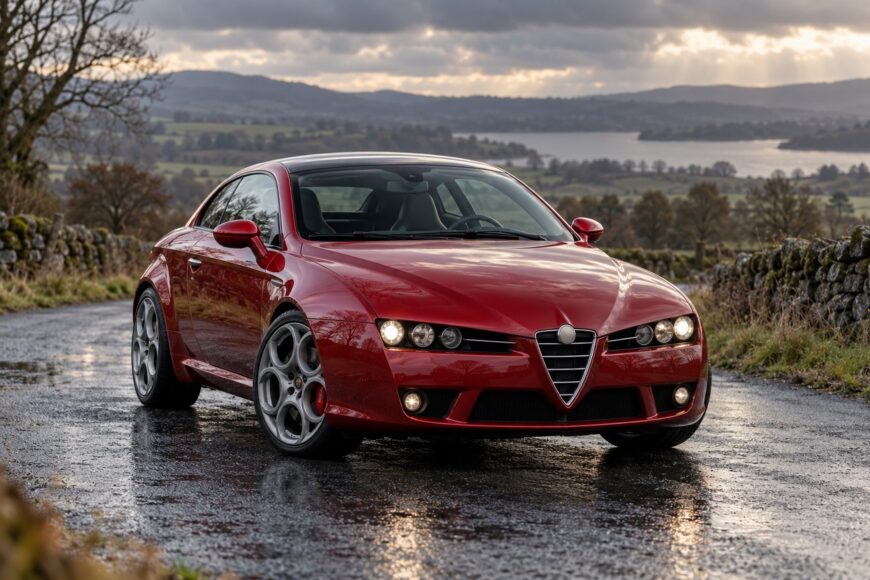
The Alfa Romeo Brera S pairs the coupé’s distinctive shape with a limited, UK-market production run. Its numbered status adds interest, but it does not tell you whether the suspension, wheels, and underside have survived years of use in good condition. Those parts matter more to the driving experience than the badge.
Prodrive’s work was a handling exercise, not an engine tune. The S kept the regular Brera’s stated power outputs while changing how the car sits, rides, and responds on the road. For a used buyer, that makes originality and chassis condition central to the appeal—and potentially costly to put right.
- Why the UK-only Brera S exists
- Brera S 2.2 and 3.2 V6: specifications and trade-offs
- What Prodrive actually changed
- How the lighter front-drive Brera S behaves
- Ownership costs behind the limited-edition badge
- How to verify and inspect an original Brera S
- Frequently asked questions
- Why are used Alfa Romeos often cheaper than their rarity suggests?
- How should an owner insure hard-to-replace Brera S parts?
- What should you do after hitting a pothole in a Brera S?
Why the UK-only Brera S exists
The Brera S was a UK-market series of 500 individually numbered cars, all right-hand drive. It offered a more focused version of Alfa Romeo’s coupé for British roads, rather than a track conversion. Its limited run makes identification important, particularly when a car is advertised far from its original market.
Prodrive concentrated on chassis behavior. Springs, dampers, ride height, and wheels were specified to give the Brera more controlled responses without claiming extra engine power. That distinction sets expectations: the S should feel different from an ordinary Brera, but it will not deliver a power gain under acceleration.
Nor does the badge establish that an example has superior equipment or has been maintained well. A numbered car with replacement suspension parts may drive differently from the intended specification, while a tidy exterior can conceal expensive work underneath. Buy on documented identity and present condition, then decide how much the limited run matters to you.
Brera S 2.2 and 3.2 V6: specifications and trade-offs
Both engines retained their stated outputs, and both S versions drive the front wheels. The reported weight reductions refer to different ordinary-Brera comparisons.
| Specification | 2.2 JTS Brera S | 3.2 V6 JTS Brera S |
|---|---|---|
| Stated power | 185 hp; no claimed S-specific increase | 260 hp; no claimed S-specific increase |
| Drive layout | Front-wheel drive | Front-wheel drive; no Q4 |
| Reported weight reduction | Approximately 35 kg against the relevant ordinary-Brera comparison | Approximately 100 kg against the relevant ordinary-Brera comparison, chiefly through removal of Q4 |
The 2.2 offers the smaller reported weight saving and avoids the V6’s particular fuel and servicing demands. Its appeal rests on the S chassis and the coupé itself, rather than an increase over the ordinary 2.2 JTS’s 185 hp.
The V6 supplies 260 hp, but the loss of Q4 is a major part of its weight story. That change also alters how its power reaches the road. Treat the figures as reported comparisons, not as a promise that every surviving S has a particular curb weight or driving character.
What Prodrive actually changed
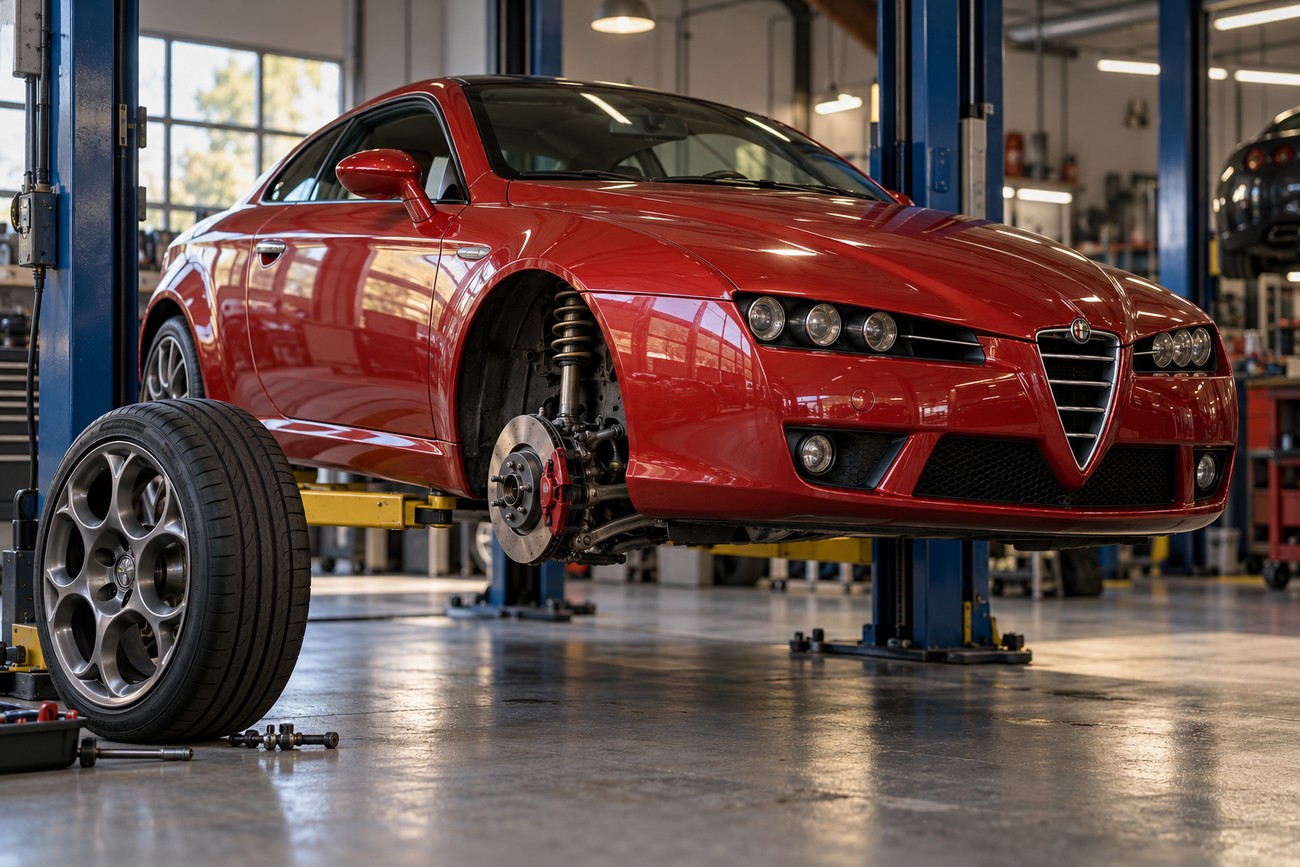
Eibach springs were described as approximately 50% stiffer, although exact spring rates were not publicly specified. Bilstein monotube dampers and a ride height lowered by 10 mm completed the principal suspension changes. Together, they aimed to restrain body movement and make the Brera respond more promptly to steering inputs.
The S also received special 19-inch wheels with a stated 235/40 tire size. Each wheel was reported to be approximately 2 kg lighter than the standard 17-inch comparison, a useful distinction from simply fitting larger rims. The lower-profile tires, however, leave less protection against pothole damage, and the firmer setup asks more of suspension components on broken surfaces.
Credit needs to be assigned carefully. Lightweight aluminum suspension elements and hollow anti-roll bars also featured in the 2008 Brera specification; they were not exclusively Prodrive additions. Attributing every lighter component to the S overstates the conversion and misrepresents the differences from an ordinary 2008 Brera.
The complete setup matters more than any single specification. A car on visually similar wheels or replacement dampers may still be enjoyable, but it no longer provides a clean test of what the S package was designed to do. The road surface matters, too: tighter control on smooth pavement can become a busy ride where repairs and potholes are frequent.
How the lighter front-drive Brera S behaves
Both Brera S engines drive the front wheels; the 3.2 S does not have Q4. Removing that system chiefly explains the V6’s reported saving of approximately 100 kg against its ordinary-Brera comparison. It changes the balance of the car, though the front tires must now handle the V6’s steering and power delivery together.
On a dry, flowing road, the stiffer chassis can make the coupé feel more settled through direction changes. Accelerating hard out of a slow bend may expose the front wheels’ traction limits instead. The Brera’s underlying mass and inertia also remain apparent in corners; reduced weight is not the same as a lightweight sports-car feel.
Published V6 curb-weight figures include 1532 kg and 1445 kg. Their equipment and measurement methods have not been reconciled, so neither number works as a universal S specification or proof of a fixed saving. If weight is important to a comparison, check that the cars and the basis of measurement genuinely match.
This is a road-focused tune, not a guarantee of composure on every road. The lower ride height and firmer springs can reward smooth inputs, yet rough surfaces can unsettle the ride and put the special wheels at risk. A test drive should include the kinds of roads on which the car will actually be used.
Ownership costs behind the limited-edition badge
The 3.2 V6 JTS retained its stated 260 hp. Buyers therefore take on its fuel and servicing demands without an S-specific power increase to offset them. Service history deserves more attention than the idea that Prodrive made the engine stronger or quicker.
Special 19-inch wheels and stated 235/40 tires make poor roads a practical ownership concern. The stiffer springs and 10 mm lower ride height can turn an impact into a tire, rim, alignment, or suspension bill. Inspect each wheel closely rather than assuming that a car that tracks straight has escaped damage.
S-specific wheels and suspension components can be harder and more expensive to replace than standard parts. A cheaper substitute may keep the car mobile, but it can change both its behavior and its claim to original specification. Before committing, establish what is fitted and whether the cost of correcting it suits your budget.
Everyday usefulness remains limited by the coupé body. Rear seats are restrictive, and luggage access is less accommodating than in a conventional hatchback. Those compromises may be acceptable for occasional use; they become harder to overlook if the Brera is expected to serve as the only car.
How to verify and inspect an original Brera S
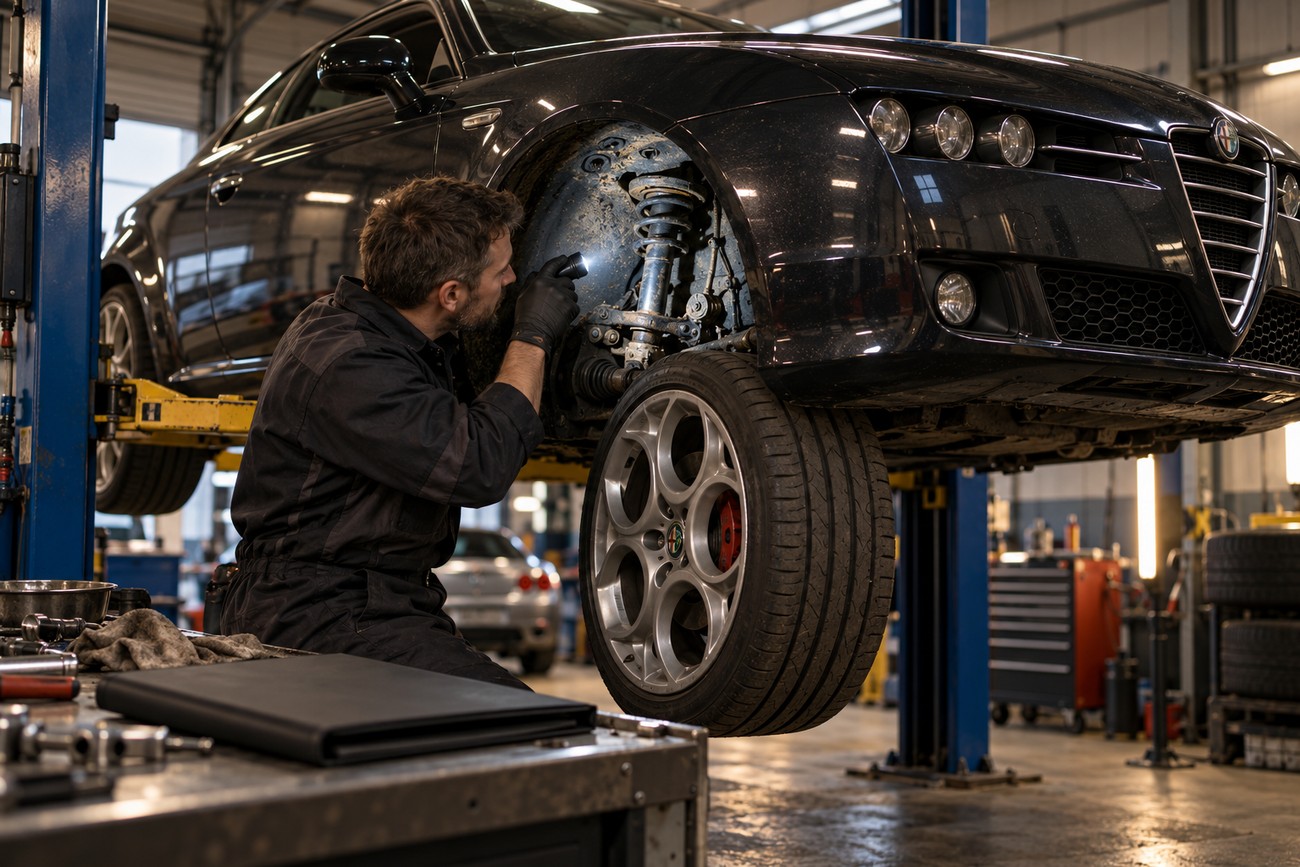
Start with identity. Reconcile the VIN with the paperwork, the evidence for the car’s individual number, and its service and ownership history. A right-hand-drive layout is consistent with the series of 500, but an S badge alone does not establish that the car belongs to it.
Next, check the hardware against the stated specification: special 19-inch wheels, Eibach springs, and Bilstein monotube dampers. Visually similar wheels do not establish originality. Record any replacements and ask why they were fitted, since a change made after damage may be more significant than a routine choice of tires.
Finally, read available MOT records for repeated or unresolved remarks about the subframe, suspension arms, and exhaust, then arrange a physical inspection. Check for wheel damage, leaking or tired dampers, and uneven tire wear; have the alignment assessed if wear or steering behavior raises concern. Records identify areas to investigate, rather than replacing an inspection underneath the car.
Put likely repairs into the purchase decision before assigning value to rarity. A complete, well-documented S may justify the effort of sourcing special parts, while a car needing wheels and suspension work can quickly narrow any apparent advantage in its asking price.
Frequently asked questions
The questions below concern costs that can be easy to miss when a Brera S first catches your eye. They are worth settling before purchase, and again when arranging insurance or dealing with road damage.
Why are used Alfa Romeos often cheaper than their rarity suggests?
Scarcity and resale demand are different things. A limited run can interest enthusiasts, while a wider pool of buyers may still account for specialist upkeep, parts availability, and the risk of future repairs. There is no universal price rule: compare a Brera S with cars of similar condition and documentation, and allow for work the individual example needs.
How should an owner insure hard-to-replace Brera S parts?
Keep photographs and records showing the car’s numbered identity, fitted wheels, suspension specification, and any replacement parts. Ask the insurer how its policy values special wheels and repairs, and what evidence it would need after a claim. Where required, disclose non-original replacements; the wording and obligations depend on the policy and location.
What should you do after hitting a pothole in a Brera S?
Stop somewhere safe and inspect the tire sidewalls and rim for visible damage. On the next drive, watch for vibration, a changed steering-wheel position, or the car pulling to one side. If damage or symptoms appear, request a wheel and alignment check before continuing normal use; an apparently intact tire does not rule out a bent wheel or disturbed alignment.







