
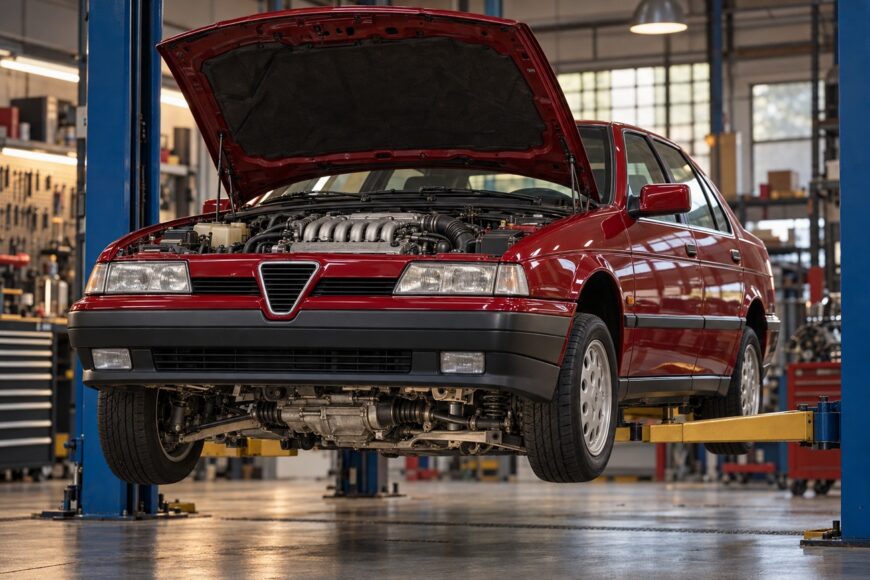
The Alfa Romeo 164 Q4 combines one of Alfa Romeo’s most charismatic engines with one of the company’s most complicated drivetrains. Its 3.0-liter Busso V6 gives the large sedan genuine pace and character, while the rare Viscomatic all-wheel-drive system can cost more to revive than the car is worth.
That contradiction defines the Q4 better than any specification sheet. It is an important Alfa Romeo with real collector appeal, yet age, corrosion, scarce drivetrain parts, and specialized electronics can turn an apparently sound example into a long-term engineering project. This guide is for assessing ownership risk as carefully as the engine’s appeal.
- Alfa Romeo 164 Q4: What It Is and Why the Dates Vary
- Alfa Romeo 164 Q4: Key Specifications
- How the Viscomatic AWD System Really Works
- Busso Performance, Weight and Road Character
- Buying a 164 Q4: The Checks That Matter Most
- Ownership Reality: Parts, Service and Originality
- Frequently asked questions
- How can I verify that a seller’s Q4 actually has working all-wheel drive?
- Why do Alfa Romeo 164 Q4 listings disagree about weight and height?
Alfa Romeo 164 Q4: What It Is and Why the Dates Vary
The Alfa Romeo 164 Q4 is an all-wheel-drive E-segment sedan based on the Alfa Romeo 164. It was positioned above the ordinary front-wheel-drive versions as a fast executive car, combining a high-output V6, a six-speed manual gearbox, and a sophisticated traction system. The Q4 is therefore more than a cosmetic package or a conventional 164 with extra driven hardware added underneath.
Its engine is the AR64308 3.0 V6 24V Busso, with 2959 cm³, multi-point fuel injection, and 24 valves. Catalogue figures generally place output at 231–232 hp at 6300 rpm, with 275–280 Nm at 5000 rpm. That specification distinguishes the Q4 from earlier 12-valve cars and from less powerful versions of the 164 range.
Production dates are reported inconsistently. Some catalogues list the Q4 across 1993–1998, while other sources place the all-wheel-drive sales launch in 1994–1995. The difference is best treated as a source and market distinction involving production, registration, and sales dates, rather than as proof that one side of the disagreement is automatically wrong.
The important buying point is configuration. A Q4 carries its own drivetrain, electronics, suspension, and service requirements, so its condition cannot be judged by comparing it with a simpler front-wheel-drive 164 V6. A car that looks like a rare trim level may actually require a separate inspection strategy from the rest of the model range.
Alfa Romeo 164 Q4: Key Specifications
The following figures summarize the commonly listed Q4 specification. Ranges are retained where catalogues and markets differ, and the fuel-consumption figures are official values rather than a promise of what an aged example will deliver in daily use.
| Item | Alfa Romeo 164 Q4 specification |
|---|---|
| Engine | AR64308 3.0 V6 24V Busso, 2959 cm³, multi-point fuel injection, 24 valves |
| Power | 231–232 hp at 6300 rpm |
| Torque | 275–280 Nm at 5000 rpm |
| Engine layout | Front-transverse |
| All-wheel-drive system | Viscomatic: central viscous coupling, planetary center differential, and rear Torsen differential |
| Transmission | Six-speed manual gearbox only for the Q4 AWD configuration |
| 0–100 km/h | 7.3–7.5 seconds |
| Top speed | 237–240 km/h |
| Kerb weight | 1510–1680 kg, depending on source and market |
| Length | 4555 mm |
| Width | 1760 mm |
| Height | 1355–1390 mm |
| Wheelbase | 2660 mm |
| Ground clearance | Approximately 140 mm |
| Official urban fuel consumption | Approximately 14.5 l/100 km |
| Official extra-urban fuel consumption | Approximately 7.9 l/100 km |
| Official combined fuel consumption | Approximately 10.8 l/100 km |
Variation in weight and height is normal for an old, market-dependent model whose data was reproduced by different catalogues. Equipment, measurement conventions, and regional specifications can all affect the published number. A discrepancy should prompt verification of the car’s identity and documentation, rather than being treated on its own as evidence of a wrongly advertised model.
How the Viscomatic AWD System Really Works
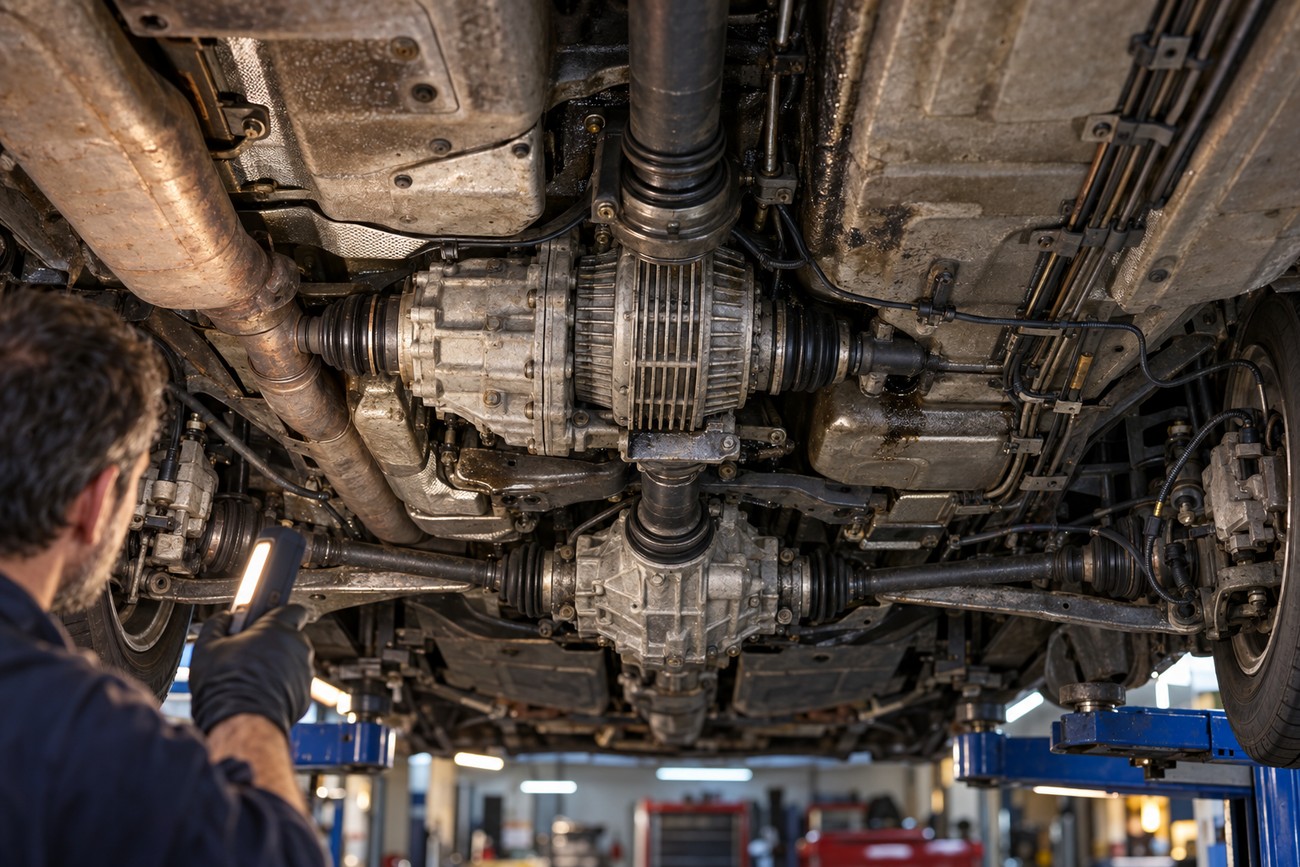
Viscomatic combines a central viscous coupling, a planetary center differential, and a rear Torsen differential. The system is integrated with the ABS and the engine control unit, making the Q4 more electronically coordinated than a simple mechanical four-wheel-drive layout. Its purpose is to vary the delivery of torque as grip, driver input, and vehicle behavior change.
The torque distribution is influenced by ABS data, steering angle, throttle opening, and related control inputs. This means the car does not operate according to a rigid permanent 47/53 split. That often-repeated description is an oversimplification and should not be used as the canonical definition of the Q4 system.
In a healthy car, the control strategy can make the Q4 feel secure without constantly announcing how much work the drivetrain is doing. That subtlety also creates a diagnostic trap. An ABS sensor fault, a damaged control unit, a wiring problem, or an electronic fault in the Viscomatic system can leave the car effectively operating as front-wheel drive.
The change may not be obvious during a gentle road test. The engine still runs, the gearbox still selects its ratios, and the car may feel normal on dry pavement. A seller’s statement that the warning light is only an electrical nuisance is therefore insufficient; the fault may have disabled the feature that makes the Q4 a Q4.
Testing must connect electronic diagnosis with physical behavior. The ABS and engine-control systems should be scanned, the Viscomatic should be assessed under appropriate load, and the center and rear drivetrain should be inspected for noise, leaks, and mechanical damage. This is a system whose condition cannot be established from a badge, a short drive, or a single dashboard check.
Busso Performance, Weight and Road Character
The AR64308 Busso produces 231–232 hp at 6300 rpm and 275–280 Nm at 5000 rpm. Its appeal is broader than the figures: throttle response, a distinctive V6 sound, and a willingness to work through the upper part of the rev range give the 164 Q4 a character that modern efficiency-focused sedans rarely reproduce.
Published performance of 7.3–7.5 seconds from 0–100 km/h and a 237–240 km/h top speed still make the Q4 a fast car. The all-wheel-drive system can help the car deploy its power, particularly when the surface is imperfect. It gives the large sedan confidence and composure rather than turning it into a lightweight track machine.
The trade-off is mass. The listed kerb-weight range of 1510–1680 kg is higher than that of lighter front-wheel-drive 164 configurations, and the additional hardware adds work for the brakes, suspension, driveshafts, and differentials. The result is best understood as a sophisticated grand-touring sedan: stable, rapid, and rewarding on a long road, with less delicacy than a smaller sports car.
Official consumption is approximately 14.5 l/100 km in urban driving, 7.9 l/100 km extra-urban, and 10.8 l/100 km combined. Those values provide a period baseline, not a realistic guarantee for a decades-old car. Age-related sensor faults, cooling problems, poor maintenance, tire drag, drivetrain friction, and frequent short trips can make the ownership budget substantially less friendly.
Buying a 164 Q4: The Checks That Matter Most
Begin with the body shell and underbody. Corrosion is a major risk, particularly on cars from wet or northern regions, and structural rust can make a restoration economically irrational even when the exterior still presents well. Inspect the underside, suspension mounting areas, floor sections, seams, and repaired panels rather than relying on a glossy paint finish.
A clean body does not prove that the AWD system works. A complete inspection should include ABS sensors and control units, Viscomatic electronics, wiring, connectors, the central coupling, planetary differential, rear Torsen unit, driveshafts, and associated seals. Drivetrain noises, vibration, fluid leaks, or unexplained warning lights deserve a written diagnosis before any purchase decision.
Suspension and brakes need their own assessment because Q4-specific parts may differ from those used on ordinary front-wheel-drive 164 versions. The additional mass and driven hardware increase the consequences of worn bushings, tired dampers, bent components, or neglected brakes. Confirm the exact part application before assuming that a familiar 164 replacement will fit.
Wheels and tires are another practical checkpoint. Non-standard wheel sizes, incorrect rolling diameters, or mismatched tires can confuse ABS signals and produce incorrect traction behavior. The car should be checked with a coherent set of suitable tires, and any modification should be treated as a technical question rather than an aesthetic improvement.
Restoring the AWD system and suspension can cost more than the vehicle’s market value. The disciplined rule is simple: buy only after a specialist inspection has identified the defects, confirmed parts availability, and produced a credible repair budget. Rarity is a reason to inspect carefully, not a reason to waive the inspection.
Ownership Reality: Parts, Service and Originality
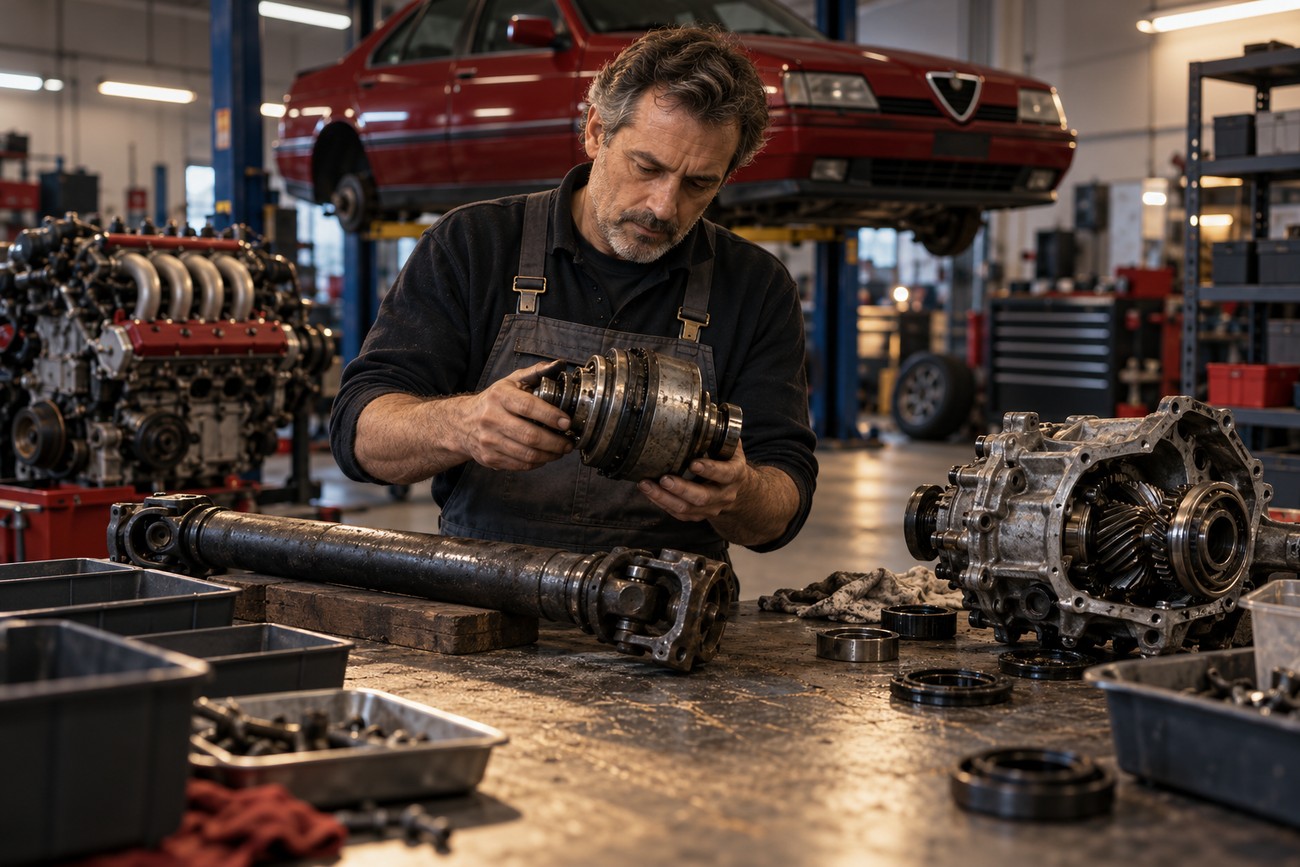
Q4 ownership requires access to the right knowledge as much as access to tools. Many general Alfa Romeo specialists understand Busso engines and ordinary 164 maintenance, yet still decline Q4 work because Viscomatic diagnosis and repair demand different experience. A workshop that can replace a clutch or service a V6 may not be equipped to identify a fault in the integrated AWD control system.
Original drivetrain parts are scarce. Viscomatic couplings, planetary differentials, rear Torsen units, and driveshafts may require lengthy searches for used components or donor cars. This makes a complete, functioning system disproportionately valuable: buying a cheaper car with missing or damaged hardware can be more expensive than buying a better example from the outset.
The Busso also deserves conservative preventive maintenance. On an aging engine, timing-belt work and cooling-system attention should be approached more frequently and cautiously than a period schedule might suggest. Oil, coolant, and drivetrain fluids must meet the correct specifications, because unsuitable fluids or deferred cooling repairs can accelerate wear in both the engine and the AWD hardware.
Electrical condition is part of originality and reliability. Moisture and age can damage ABS sensors, control units, wiring, and connectors, while improvised repairs may create faults that are harder to trace than the original problem. A factory-style harness and documented repair are worth preserving; random additions to the wiring can reduce both usability and future diagnostic value.
The strongest collector case is an original Q4 with its factory drivetrain, wiring, specification, and unmodified body. A conversion to front-wheel drive may allow a car to move again, yet it removes the defining mechanical feature and reduces originality and collector appeal. Such a car should be valued as a modified 164 project, not presented as an intact Q4.
Frequently asked questions
These two checks address the most common points of confusion when comparing Q4 advertisements and inspecting a potential purchase. The key is to verify function and provenance rather than relying on a familiar description in a listing.
How can I verify that a seller’s Q4 actually has working all-wheel drive?
Start with a cold visual inspection and a diagnostic scan of the ABS and engine-control systems. Record stored and active faults, inspect the sensors and connectors, and confirm that the warning lamps behave normally at startup. Then carry out a controlled road test on a suitable surface, checking for unusual drivetrain noise, vibration, binding, or behavior that suggests the car is delivering power only through the front wheels.
A physical inspection must follow the scan. Verify the central viscous coupling, planetary differential, rear Torsen unit, driveshafts, and fluid condition, because an apparently minor electronic fault can leave the Q4 effectively front-wheel drive. The seller should be able to provide a credible repair history and allow independent testing; the badge and a short dry-road drive are not proof of working AWD.
Why do Alfa Romeo 164 Q4 listings disagree about weight and height?
Catalogue differences usually reflect source and market variation, along with different equipment and measurement conventions. Published kerb weight ranges from 1510–1680 kg, while listed height ranges from 1355–1390 mm, so a small numerical disagreement does not automatically mean that an advertisement describes the wrong model.
Use the figures as a cross-check alongside the engine code, six-speed manual gearbox, Viscomatic hardware, documentation, and physical identity of the car. If several details conflict at once, investigate the specification and history; if only one catalogue number differs, it may simply reflect how that market recorded the car.







