
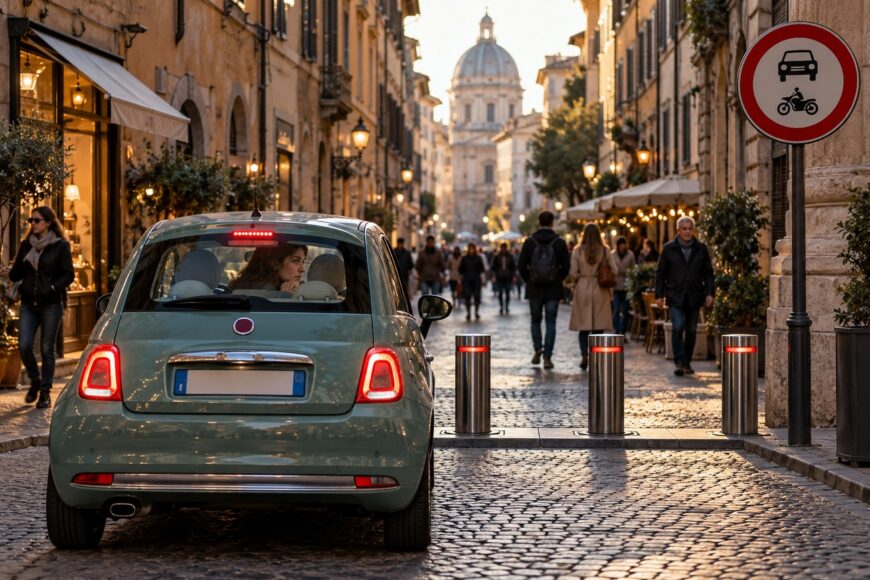
A compact Fiat 500 can follow a navigation route into a street that appears open to traffic, while the pedestrian-zone restriction becomes clear only at the final sign, bollard, or road marking. By then, there may be no safe place to turn around, and pedestrians may be using the full width of the street.
The Fiat 500’s small dimensions and low speed do not create permission to enter. The immediate priorities are to protect pedestrians, avoid damage or obstruction, follow visible traffic-control instructions, and understand that any enforcement or liability outcome depends on the country, municipality, signs, and circumstances.
- What a pedestrian zone sign actually means
- You have entered by mistake: the safest next move
- Why navigation and the Fiat 500’s city-car image can mislead you
- Fines, cameras, and responsibility beyond the ticket
- How to prevent the same mistake on the next city drive
- Frequently asked questions
- Why don’t people like Fiat 500s?
- What might you be charged with for hitting a pedestrian?
What a pedestrian zone sign actually means
Terms such as “pedestrian zone,” “Fußgängerzone,” and “zone piétonne” generally indicate a restricted area where motor-vehicle access is prohibited unless an explicitly applicable local exception exists. The restriction usually concerns access itself, rather than simply imposing a low-speed limit.
Possible exceptions include residents, deliveries, taxis, emergency services, or other locally defined categories. These exceptions may apply only during particular hours, for particular purposes, or to vehicles whose registration number has been entered into a local system.
There is no single EU-wide pedestrian-zone rule. National traffic law and municipal regulations determine the signs, access conditions, exemptions, enforcement methods, and appeal processes in each location.
A zone may allow loading, drop-off, or access to a property while prohibiting through traffic. That distinction matters: being allowed to reach an address for a permitted purpose does not necessarily authorize driving through the zone as a shortcut.
You have entered by mistake: the safest next move
Reduce speed smoothly and give pedestrians priority. Avoid sudden reversing, rapid turns, or attempts to pass through a crowd, and follow any visible instructions from officers, signals, bollards, or other access-control equipment.
Stop only where doing so will not block a doorway, emergency route, delivery area, or pedestrian movement. If a safe route out is clearly available, take it cautiously. If turning would require crossing a busy pedestrian area or touching a bollard, wait for appropriate assistance rather than forcing the maneuver.
The Fiat 500’s compact dimensions can help with positioning, but its turning radius is useful only where there is enough space to maneuver safely. Small size does not make the entry legal, and a rushed exit can create a separate risk involving pedestrians, curbs, shopfronts, bollards, or other infrastructure.
Once you are clear of the area, record the relevant sign, supplementary panel, road marking, time, route, and navigation instruction if it is safe and lawful to do so. Keep the notice and any access information, but treat this material as evidence for a local review rather than as a guarantee that a fine will be canceled.
Why navigation and the Fiat 500’s city-car image can mislead you
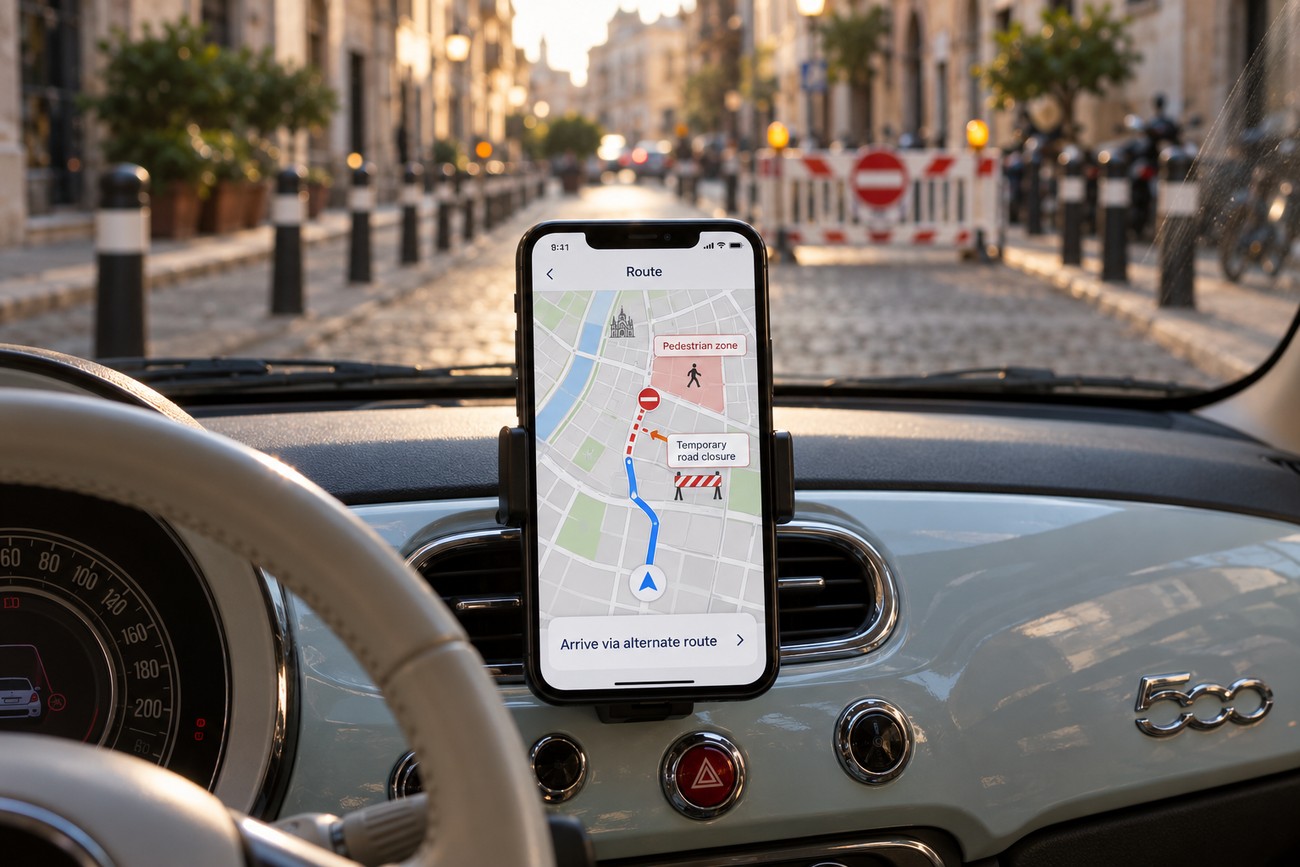
Navigation databases can lag behind temporary restrictions, new bollards, cameras, and altered access schemes. Event-related changes may be introduced after a map update, so a route that was previously usable can become unsuitable without the device clearly explaining why.
Central streets also look alike, and signs may be grouped with time panels, vehicle-category exemptions, and local symbols. A permitted parking area near a pedestrian zone can add to the confusion: parking access may be allowed from one approach even though driving through the same street is prohibited.
The Fiat 500’s “ideal for the city” image refers to its size and maneuverability. It does not mean that the vehicle may use every central street, pass every bollard, or enter every restricted area. Access depends on signs, time windows, vehicle categories, registration, and local restrictions.
Parking sensors and cameras help with positioning, but they do not replace reading signs or checking access permission. A system can warn that an obstacle is close while giving no legal indication that the road beyond it is closed to ordinary motor vehicles.
Fines, cameras, and responsibility beyond the ticket
A penalty often follows from violating the access regime itself, rather than from the Fiat 500’s size or the driver’s low speed. Moving carefully and causing no visible damage may be relevant to the circumstances, but it does not automatically turn a prohibited entry into a permitted one.
Depending on the city, enforcement may involve officers, automated cameras, bollards, or other access-control systems. A camera can record an entry without an officer stopping the vehicle, and the resulting notice may arrive later through the procedure used in that jurisdiction.
Possible consequences include a fine and, in some locations, towing or removal. The exact outcome depends on the country, municipality, wording of the notice, vehicle registration, applicable exception, and surrounding facts.
Additional responsibility may arise if the vehicle threatens pedestrians, blocks passage, or damages public or private property. Claims may concern bollards, curbs, shopfronts, paving, or other infrastructure, while a collision with a pedestrian can trigger a separate investigation under the relevant local law.
How to prevent the same mistake on the next city drive
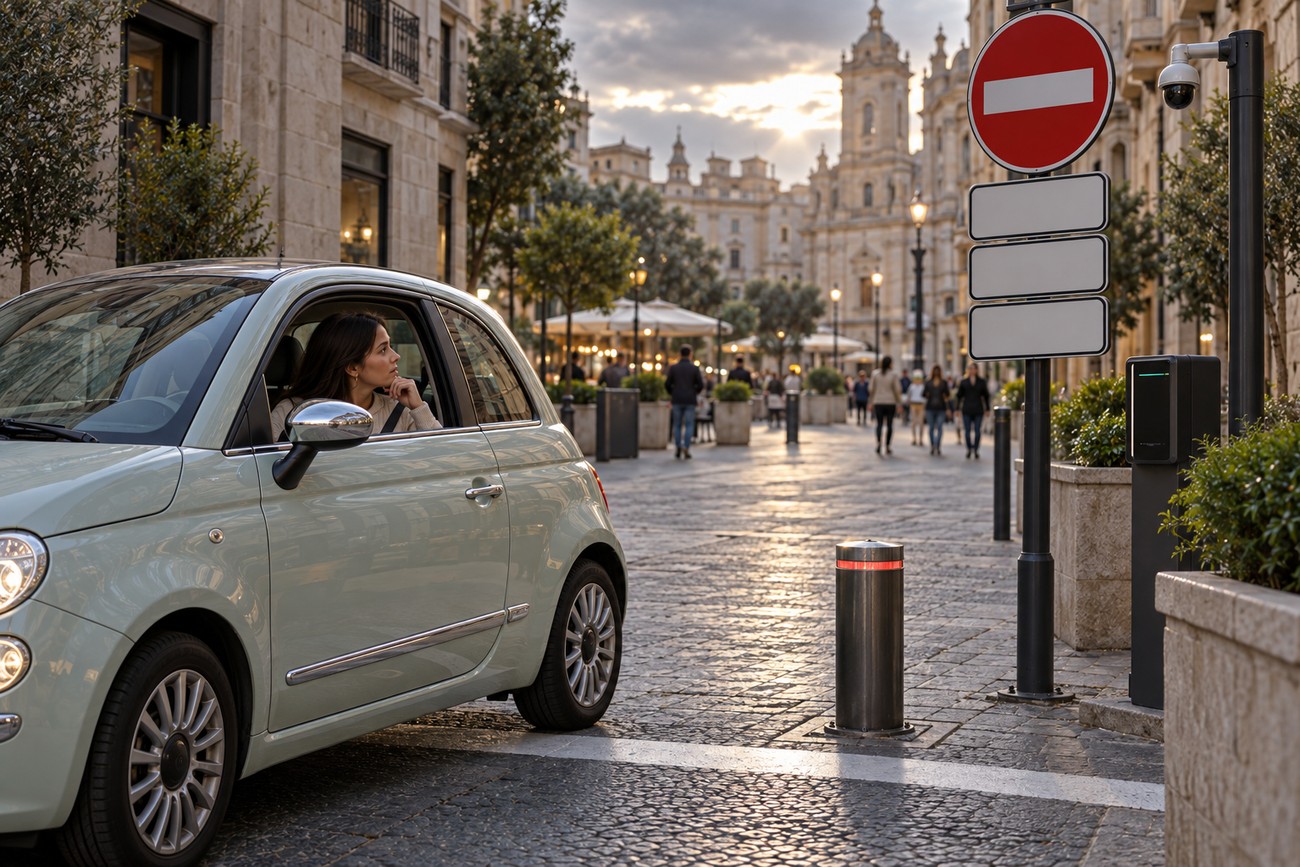
Before crossing an access point, slow down early and read the main sign together with every supplementary panel. Check the permitted hours, vehicle category, purpose of access, and whether a resident or delivery exception requires prior registration or specific authorization.
Look for signs of controlled entry, including cameras, RFID equipment, or retractable bollards. Road markings can support enforcement alongside a sign, so failing to notice the sign does not necessarily remove the importance of the marked access boundary.
Navigation should remain guidance rather than authority. If the route conflicts with a visible sign, the sign and local traffic-control arrangement take priority; choose another route instead of assuming that the map knows about a recent restriction.
Allow for temporary pedestrian-zone extensions during events, street works, or local activities. Also distinguish permitted loading or drop-off from prohibited transit, and remember that low speed alone does not make restricted entry lawful.
Frequently asked questions
Why don’t people like Fiat 500s?
Opinions about Fiat 500s usually concern styling, interior space, ride comfort, visibility, ownership experience, or the vehicle’s suitability for particular drivers. Those subjective complaints have no bearing on pedestrian-zone access.
A Fiat 500 is a compact city car, but its reputation, ownership model, and dimensions do not determine whether it may enter a restricted area. The relevant factors are the local sign, applicable exception, access hours, registration requirements, and the purpose of the journey.
What might you be charged with for hitting a pedestrian?
There is no single universal charge. Depending on the jurisdiction, injury, evidence, and degree of fault, the matter may involve a traffic offense, a negligence-based offense, or more serious criminal allegations.
The investigation may also consider speed, visibility, road layout, warnings, pedestrian behavior, vehicle condition, and the driver’s actions immediately before and after the collision. The pedestrian-zone entry may create a separate access violation, while any injury or property damage is assessed under the relevant local procedure.







