
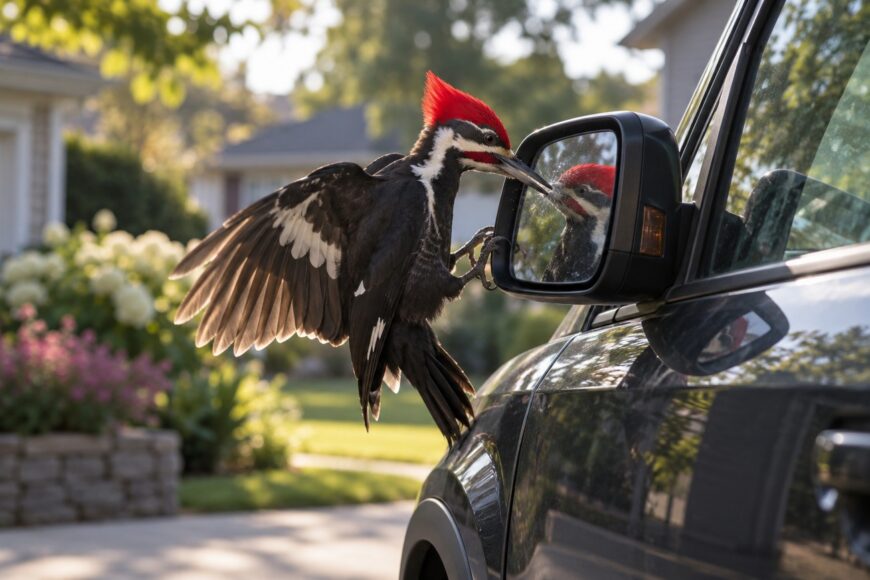
A woodpecker repeatedly striking a parked Kia Soul’s side mirror is usually responding to what it sees rather than trying to damage the vehicle. Your immediate choice is simple: keep chasing the bird away or remove the reflection that may be bringing it back.
While the Soul is parked, cover the mirror from outside or move the car, then inspect the glass, housing, and electrical functions. A working adjustment motor does not prove that every part of the mirror survived the attacks.
- Why a Woodpecker Targets the Side Mirror
- What to Do While the Bird Is Attacking
- Check the Mirror Before Buying a Replacement
- Prevent Another Attack Without New Risks
- Frequently asked questions
- What if a bird only sits on my car mirror but never pecks it?
- What time of year do woodpeckers peck on houses?
- How to keep birds off car side mirrors?
- What does it mean when a bird sits on your car mirror?
- How to get rid of wasp nest in car mirror?
Why a Woodpecker Targets the Side Mirror
A woodpecker may react to its reflection as though it were a rival bird. The mirror presents a sharp, repeated image in the same place, which can trigger territorial behavior. This is a likely explanation, not a confirmed cause of every encounter.
Chasing the bird away may end one attack while leaving the trigger unchanged. If the Soul returns to the same parking spot and the mirror remains uncovered, the bird may come back and resume striking, especially during the part of the day when it first noticed the reflection.
The behavior does not by itself indicate a Kia Soul defect. Available owner reports do not establish how common woodpecker attacks are specifically among Soul owners, and a bird can choose any reflective vehicle surface in a particular territory.
Look for a pattern before assuming the bird caused every mark. A fresh chip, cracked glass, loosened mirror, or damaged turn-signal lens supports that conclusion; unrelated parking damage or a pre-existing fault may look similar.
What to Do While the Bird Is Attacking
Start by removing access to the reflection. While the Kia is parked, temporarily cover the mirror glass from outside with a removable, non-sticky cover, or move the vehicle to a different location. This addresses the likely visual trigger before you add a deterrent.
Use a cover that can be removed without adhesive residue and that does not press against fragile glass or interfere with the folding joint. There is no Kia Soul-specific official test or instruction identifying a bird-proof mirror-cover material, so treat any product claim cautiously.
Remove the cover completely before driving. Kia instructs drivers to adjust the outside mirrors before driving and not to adjust them while the vehicle is moving. An uncovered, correctly positioned mirror is part of maintaining the intended view around the car.
Sticky gels, tape, or other adhesive repellents create avoidable problems. Extension guidance discourages sticky repellents because they can trap or injure birds and other animals. If moving the car is practical, changing the parking spot is usually the cleanest first response.
Check the Mirror Before Buying a Replacement
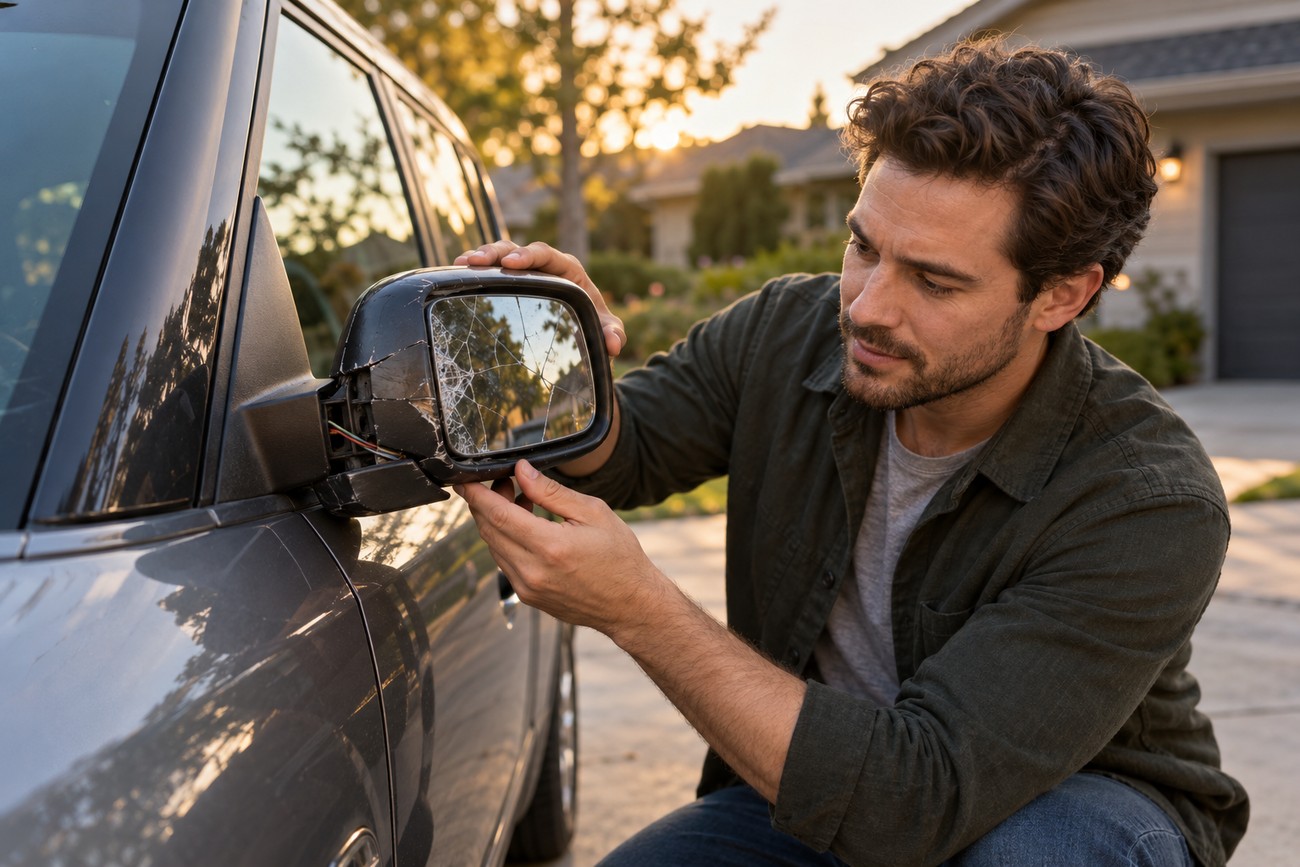
Inspect the mirror with the vehicle parked and the ignition off unless a function check requires power. Examine the reflective element for cracks, chips, looseness, or movement, then check the plastic housing and the folding joint for splits or abnormal play. Look around the base for displaced trim or exposed wiring.
With the car safely stationary, select the mirror marked L or R and test the electric adjustment in each direction. If equipped, check heating and the turn signal separately. The mirror assembly may include glass, an adjustment drive, folding hardware, heating wiring, and a signal lamp, so one working function does not clear the others.
Electric adjustment can still work with a loose glass mount or a failed heating connection. A function check should cover each equipped feature rather than stopping when the mirror moves.
If only the reflective element is damaged, separate replacement glass may be possible. Match the model year, left or right side, heating equipment, electric features, and attachment type before ordering. Parts listed simply for “Kia Soul” may still use different fittings or equipment.
A complete mirror assembly can cost more because it may require painting or transferring equipment from the old unit. If the housing, mount, wiring, or signal lamp is damaged, compare the repair options with a technician before buying a whole assembly.
Prevent Another Attack Without New Risks
Physical protection and bird deterrence solve different problems. A removable cover or a different parking location protects the parked mirror immediately; changing the bird’s behavior may require reducing the attraction around the parking area.
If attacks occur at a predictable time, such as early morning, park elsewhere during that period when possible. Also check for a nearby branch, dead tree, or other perch that gives the bird a clear view of the mirror. Removing or blocking that attraction can help, provided the work is safe and permitted.
Extension guidance includes visual deterrents, noise, exclusion, and alternative locations, with inconsistent results from individual methods. Moving reflective strips or predator silhouettes may help for a while, although birds can become accustomed to them. Preliminary findings involving a roughly 7.5-inch convex mirror and hawk silhouettes concern buildings, not Kia Soul mirrors.
Avoid rigid add-ons that can crack on impact, adhesives that can trap wildlife, and anything that blocks visibility or prevents automatic folding. Kia’s mirror guidance explains adjustment and safe use; it does not certify universal protection against woodpeckers. Recheck the mirror after each incident, even if the bird stops returning.
Frequently asked questions
The bird’s behavior can provide a useful clue, but the safest response depends on what it is actually doing and whether the vehicle has sustained damage.
What if a bird only sits on my car mirror but never pecks it?
A bird sitting on the mirror may be using it as a perch, lookout point, or resting place. Watch for actual strikes, fresh scratches, loose glass, or new cracks before attributing damage to the bird. A perch alone does not show that the reflection is causing a territorial response.
What time of year do woodpeckers peck on houses?
Woodpeckers may peck during breeding and territorial periods, while searching for food, or when they find a useful surface for drumming. Timing varies by species, location, and weather, so a seasonal pattern is only a clue. A mirror attack can still occur outside the period you expect.
How to keep birds off car side mirrors?
While parked, cover the reflective surface from outside or move the car, and remove the cover before driving. If possible, alter the parking location or reduce a nearby perch. Visual and noise deterrents can supplement these steps, but their effect may fade as the bird becomes accustomed to them.
What does it mean when a bird sits on your car mirror?
It may simply be resting or using the mirror as a high viewing point. If it repeatedly faces the glass, attacks its image, and returns after being chased away, a territorial response to the reflection becomes more plausible. The behavior alone does not identify a fault with the Kia Soul.
How to get rid of wasp nest in car mirror?
A wasp nest requires a different response from a woodpecker attacking a reflection. Avoid reaching into the mirror or spraying blindly, since the nest may be concealed near wiring or a folding mechanism. Keep people away and consider a qualified pest-control service; insurance coverage for resulting damage depends on the policy and deductible.







