
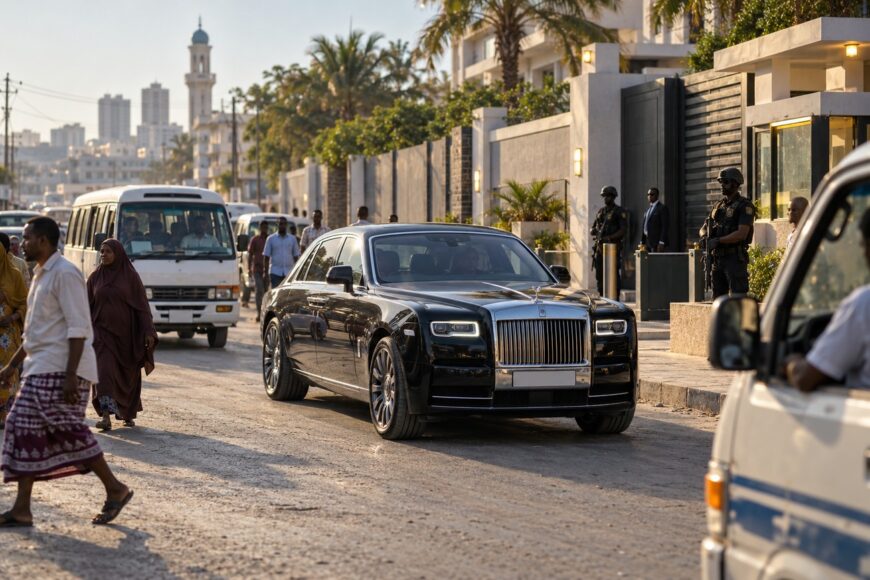
A Rolls-Royce Phantom draws attention that an ordinary taxi rarely does. Its quiet cabin and imposing body suggest a carefully planned arrival, while a taxi journey usually begins with a simpler need: getting across town. In Mogadishu, the difference matters. A striking photograph or the label “taxi” leaves a central question unresolved: is the car available to the public, booked privately for particular passengers, or simply described as a taxi?
The distinction is more than a matter of wording. It determines who can book the car, how a fare might be agreed, and whether the vehicle tells us anything about everyday transport in the city. The available material makes the Phantom an intriguing subject, but it does not document a Mogadishu taxi service built around one.
- Is there really a Phantom taxi in Mogadishu?
- A street taxi or a chauffeured VIP booking?
- What it would cost to keep a Phantom on the road
- When luxury changes the passenger experience
- What one luxury car can—and cannot—say about Mogadishu
- If someone offers a Phantom ride, what should you confirm?
- Frequently asked questions
- What is the most popular car brand in Somalia?
- How much does a car cost in Somalia?
- Which country uses Rolls-Royce cars as taxis?
- How can I check whether a viral Phantom taxi photo is authentic?
Is there really a Phantom taxi in Mogadishu?
The supplied material does not establish a publicly verifiable registration or operating record for a Rolls-Royce Phantom taxi in Mogadishu. That limits what can be said about any purported vehicle’s owner, schedule, customers, or availability. It does not prove that no such service exists; accessible records and published reporting can be incomplete.
A photograph would establish only that a car resembling a Phantom appeared in front of a camera, assuming the image and location were authenticated. A caption calling it a taxi adds a claim, not proof of paid rides. Even evidence of one paid journey would leave open whether the car was offered to anyone or reserved through a private arrangement.
To establish a public taxi service, the useful evidence would be independently checkable booking information, consistent accounts of ordinary customers obtaining rides, or an operating record tied to the vehicle. Those details matter more than the novelty of the car. Without them, calling it a “Phantom taxi” risks turning a description into a business model.
A street taxi or a chauffeured VIP booking?
Prearranged private or VIP hire is a plausible explanation for a luxury-car ride, though it is not a verified description of any particular Mogadishu Phantom. A car booked for a wedding or a specific guest can carry paying passengers without functioning as a street-hail taxi. The difference is whether an ordinary customer can request it on predictable terms.
Local accounts describe older Japanese sedans, including Toyota Corollas and Mark IIs, as familiar taxi vehicles. Those accounts offer context for the contrast, not a fleet count or a ranking of Somalia’s most popular cars. A sedan used throughout the day can serve many short trips; a chauffeured luxury car may be committed to one booking and its timing.
The driver’s responsibilities could also change the service. For a prearranged trip, meeting passengers at an agreed location and coordinating a destination may be part of what they pay for. It would be a mistake, however, to assume that any driver provides security or special access simply because the vehicle is expensive.
Price is the clearest unanswered question for a potential passenger. No verified public fare for a Mogadishu Phantom ride is available in the supplied material. Individually negotiated terms, if such bookings exist, would say little about what a street taxi costs or whether the Phantom can be booked by the general public.
What it would cost to keep a Phantom on the road

A new Rolls-Royce Phantom starts at approximately US$500,000–$600,000 in US and European markets before options. That is a starting price in those markets, not a verified Somali purchase or import price. Transport, taxes or other charges, and the condition of any used vehicle would have to be established before estimating what an owner in Mogadishu actually paid.
Purchase cost is only one obstacle to using the car for paid rides. The Phantom requires suitable tires, careful maintenance, and specialist attention when its complex systems develop faults. Imported parts and access to qualified diagnostics are potential constraints; the supplied material establishes no specific Mogadishu repair bill or period of downtime.
A diagnostic fault can take a hire car out of service even when it still looks ready for passengers. If the correct part and qualified technician are difficult to reach, bookings may have to stop well before a repair price is known.
Road wear, fuel use in traffic, and secure storage would also affect an operator’s costs. Skimping on tires or using unsuitable replacement parts to keep the car working could create a separate safety and reliability problem. Claims about unusually large repair bills or particular insurance arrangements in informal accounts are leads to investigate, not established local tariffs.
Revenue cannot be inferred from the car’s price or its ability to attract attention. No verified public Mogadishu Phantom fare, operating-cost schedule, booking channel, or return-on-investment figure is available in the supplied material. A credible profit calculation would need to account for paid booking days as well as the days when the car is waiting for customers, parts, or service.
When luxury changes the passenger experience
A Phantom’s cabin may offer a quieter ride than an older sedan, but comfort is only one part of a journey. An unusually conspicuous vehicle can draw attention that some passengers would rather avoid. Whether that trade-off matters depends on who is traveling, where they are going, and the purpose of the trip.
Checkpoints and access restrictions can affect journeys in Mogadishu, with conditions varying by route and time. A driver arranging a pickup would need to confirm that the intended route and destination are workable, rather than assume the shortest route is available. Those considerations apply to transport planning generally; they do not establish that a Phantom has faced a particular incident.
For an event arrival, visibility might be part of the appeal. For a routine appointment, a less conspicuous car might feel more appropriate to the passenger. The available material does not establish any Phantom-specific targeting incident, so neither preference should be presented as a universal safety rule.
What one luxury car can—and cannot—say about Mogadishu
A purported Phantom taxi can tempt observers into a sweeping conclusion: that the city supports a broad market for luxury rides or that its streets are uniformly safe. No verified public fare or operating record establishes a mass-market Phantom taxi service in Mogadishu. Even a confirmed private booking would describe a narrow transaction, not demand across ordinary taxi journeys.
An isolated expensive vehicle would not, by itself, establish citywide prosperity or safety. It would not erase local economic activity, either. Both conclusions ask one car to stand in for the varied circumstances of a city and its residents.
The stronger transport story lies in the distinction between access and appearance. A car photographed on a street may be visually memorable; a documented service needs evidence that passengers can obtain a ride and under what terms. Until that evidence is available, “Phantom taxi” remains an intriguing description rather than an established account of how people travel in Mogadishu.
If someone offers a Phantom ride, what should you confirm?
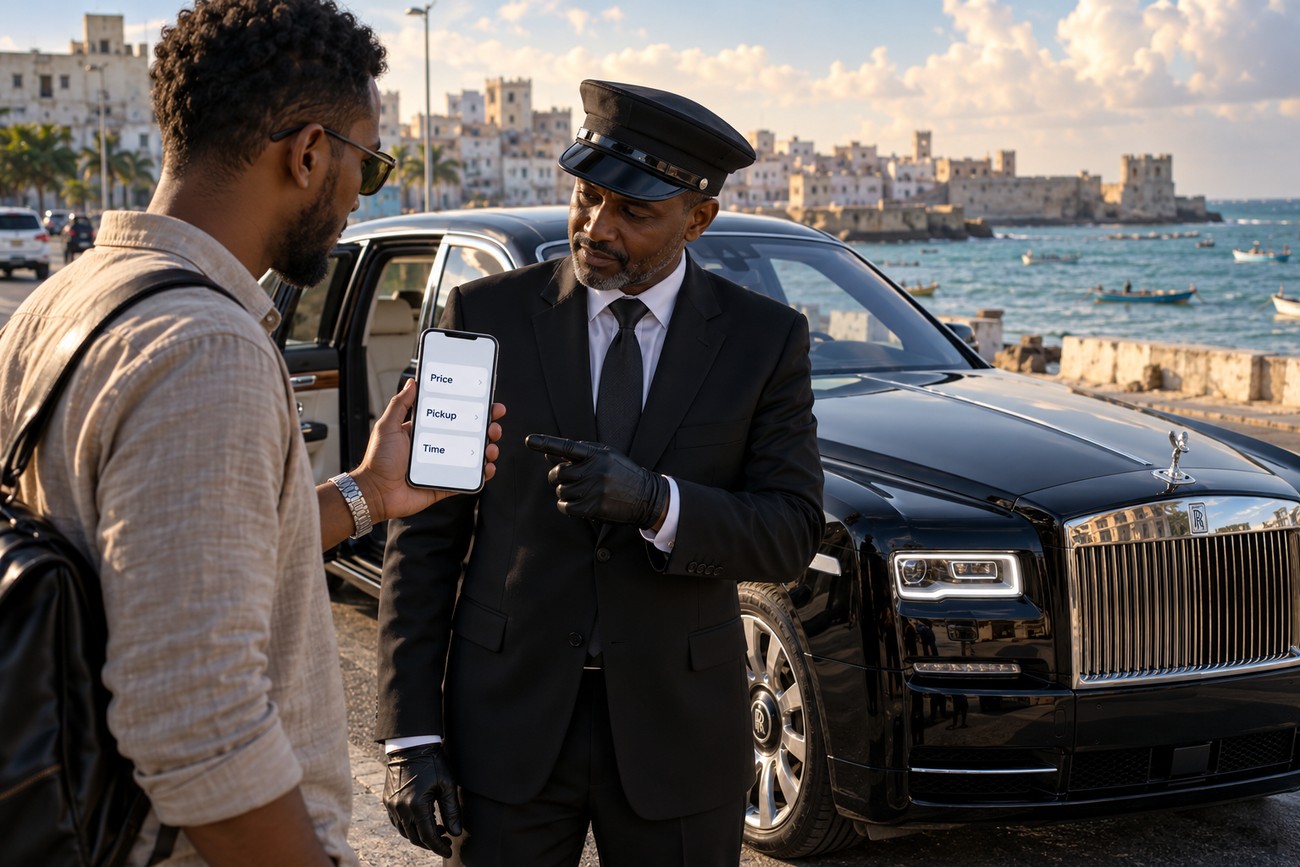
There is no verified public booking channel or fare for a Mogadishu Phantom taxi in the supplied material. Treat an offer as a specific proposed arrangement, rather than assume it is part of an established taxi service. First, confirm whether the vehicle is being offered as private hire and who is responsible for operating it.
Agree on the total price before the trip, including any waiting time or change of destination. Confirm the pickup point, destination, and how the driver will contact you if access conditions alter the plan. A clear agreement makes it easier to distinguish an actual booking from a photograph or an informal promise.
Ask what happens if the vehicle cannot complete the journey and whether another car would be provided. A distinctive badge, a social-media post, or a claimed security arrangement does not guarantee legitimacy or safety. Check the operator and current travel conditions independently where possible, just as you would for any unfamiliar transport booking.
Frequently asked questions
Several questions raised by the Phantom story concern Somalia’s wider car market and the evidence behind a viral image. The answers depend on separating local observations from national data, and a photograph from a documented service.
What is the most popular car brand in Somalia?
The supplied material does not establish Somalia’s best-selling car brand. Local accounts mention Toyota sedans, including Corollas and Mark IIs, among familiar taxi vehicles, but frequently observed cars are not the same as a substantiated national sales ranking. Such a ranking would require comparable registration or sales data across the country.
How much does a car cost in Somalia?
There is no meaningful single price for a car in Somalia: model, age, condition, import costs, and local availability all affect what a buyer may pay. A used everyday sedan and a newly imported luxury car belong to different markets.
The approximately US$500,000–$600,000 starting price for a new Phantom in US and European markets is therefore neither a general Somali car price nor a verified price for landing a Phantom in Somalia.
Which country uses Rolls-Royce cars as taxis?
The supplied material does not support naming a country where Rolls-Royce cars operate as a general taxi practice. An individual chauffeur booking, event car, or publicity vehicle might be called a “taxi,” but each describes a different level of public access. Establishing a countrywide practice would require evidence beyond an isolated booking or image.
How can I check whether a viral Phantom taxi photo is authentic?
Trace the earliest available upload and check whether later posts have changed its caption or location. Compare visible landmarks, signs, and street features with the claimed setting, while allowing for cropped images that may remove useful context.
Then look for independent evidence of the claim behind the picture: was the car actually offered for hire, and could members of the public book it? An authentic photo of a Phantom in Mogadishu would still leave that taxi question open.







