
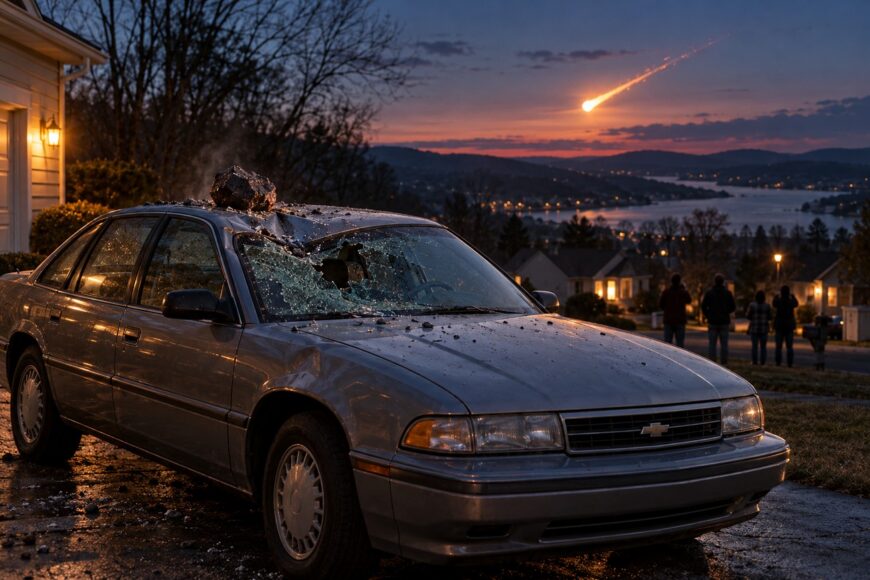
A meteorite fell onto a parked Chevrolet Malibu in Peekskill, New York, in 1992, damaging the roof and windshield before coming to rest inside the vehicle. The image is extraordinary: an ordinary passenger car became part of a documented astronomical event.
The evidence is strong, but popular retellings often blur the physics, the owner’s alleged injury, the car’s later history, and the stone’s value. The record supports a witnessed fall backed by photographs, physical evidence, catalogs, and museum documentation. Other details require more cautious wording.
- The 1992 Peekskill fall: what is actually documented
- How the meteorite damaged the Malibu
- What kind of stone was it?
- Why photographs, catalogs, and chain of custody matter
- The viral claims that need a closer look
- What the car and meteorite are worth—and why there is no simple price
- Frequently asked questions
- What happened to the Chevrolet Malibu after the meteorite hit it?
- What is the Peekskill meteorite worth today?
- Was the owner definitely hit in the leg?
The 1992 Peekskill fall: what is actually documented
The Peekskill event occurred in 1992 in Peekskill, New York. A meteorite fell onto a parked Chevrolet Malibu, damaging the vehicle before the recovered stone was documented and classified. The incident became widely known because the fall was witnessed and the car itself preserved visible evidence of the impact.
Many people observed the fireball or the meteorite’s descent, and photographic documentation helped establish the event’s sequence. Images of the damaged Malibu and the recovered stone also became part of later museum and educational displays. This evidence gives the case unusual strength compared with an isolated claim that a rock was found beside a damaged vehicle.
Meteorite catalogs identify the specimen as a witnessed fall rather than merely a find. That distinction matters. A find is recovered after an uncertain journey through the environment, while a documented fall has an observed descent and a clearer connection between the object, its landing place, and its recovery.
The case is therefore one of the best-documented examples of a meteorite striking a car. That does not make every later anecdote equally reliable. The core event is well established; individual details about injuries, ownership, repairs, or display history should be checked separately.
How the meteorite damaged the Malibu
The damage involved the roof and windshield, with documentation associating the strike with the rear section and a path into the interior or trunk area. The damage pattern is important because it shows that the stone encountered several parts of the vehicle along one trajectory. Accounts that describe only a simple hole in the roof leave out much of the physical evidence.
The meteorite entered Earth’s atmosphere at very high speed, but atmospheric drag greatly reduced its speed before ground impact. By the time a stony meteorite reaches a vehicle, it may be traveling at subsonic speeds or at tens to hundreds of meters per second, rather than retaining its original cosmic entry speed.
Penetration depends on several factors: mass, density, shape, impact angle, remaining velocity, and the barriers encountered in sequence. A compact stone striking at a favorable angle can damage sheet metal and glass, while a fragmented or shallow-angle object may produce a different result. One dramatic example cannot establish what every meteorite would do to every car.
Ordinary chondrites typically have a density of approximately 3.2–3.7 g/cm³. That is denser than most organic materials and helps explain why a substantial stone can carry considerable momentum even after atmospheric braking. Density alone, however, does not determine the damage; geometry and impact conditions are equally important.
What kind of stone was it?
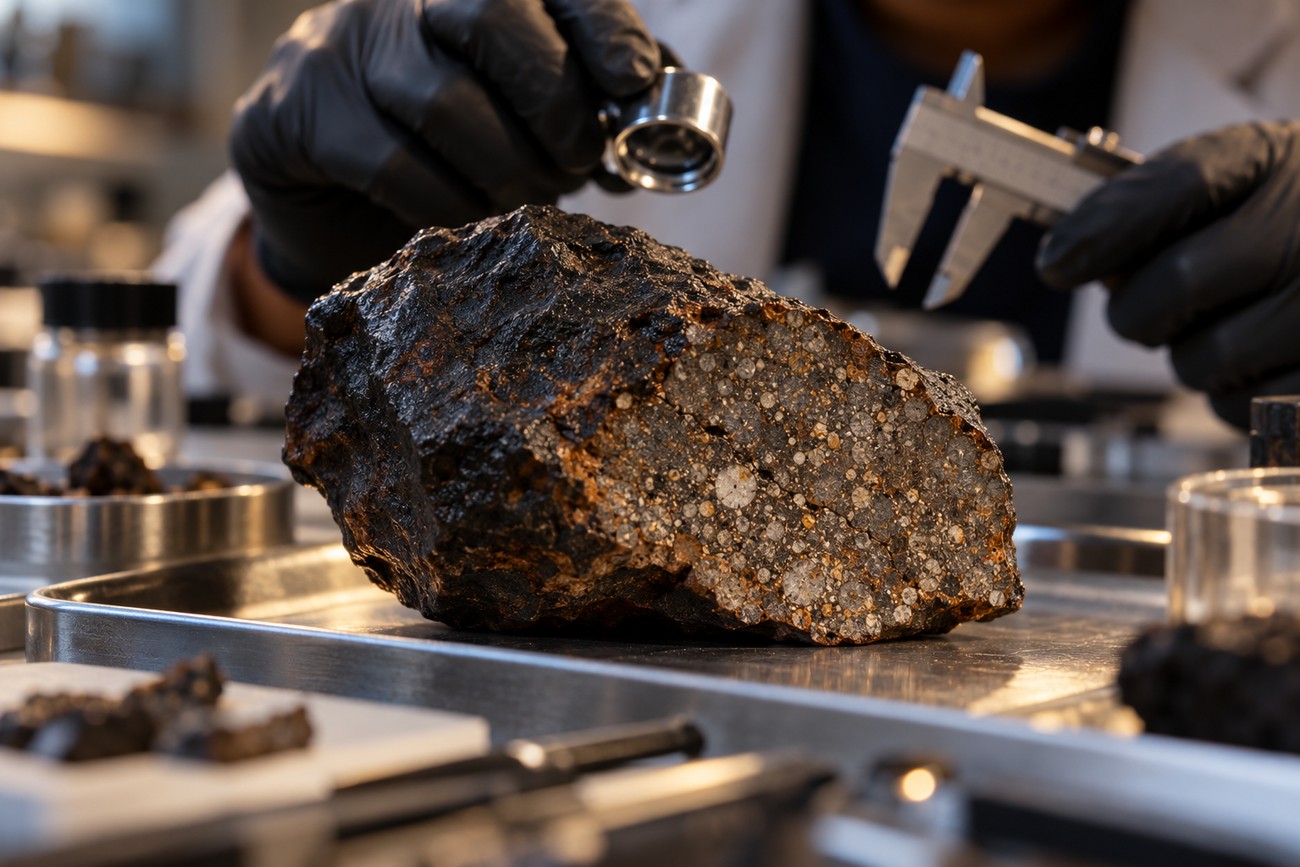
The Peekskill meteorite was classified as an ordinary chondrite, H6. “Ordinary” describes a broad and common meteorite family rather than an absence of scientific interest. Chondrites contain small mineral components and preserved evidence of early Solar System material.
The H6 designation describes a relatively high degree of thermal alteration within the ordinary-chondrite classification. It helps specialists compare the specimen with other meteorites and interpret its mineral structure. Classification requires laboratory examination, so the label cannot be established from appearance or from the fact that the rock damaged a car.
The recovered mass was approximately 12–13 kg. Its exterior could carry a fusion crust, a dark layer formed as the surface heated during atmospheric passage. That crust may coexist with an interior that remains comparatively intact, which is why a meteorite can look scorched outside without being uniformly altered throughout.
Peekskill is also a fresh fall: it was recovered soon after an observed descent. Fresh falls generally have less exposure to terrestrial contamination than old finds recovered after an unknown period on the ground. The combination of classification, recovered mass, observed fall, and physical history gives the specimen scientific and historical importance beyond the generic word “meteorite.”
Why photographs, catalogs, and chain of custody matter
The car and the stone answer different kinds of questions. An auto specialist examines glass breakage, sheet-metal deformation, roof damage, and possible movement in structural areas. A meteoriticist examines mineralogy, texture, classification, fusion crust, and evidence of terrestrial handling.
Photographs, the recorded location and time, recovery details, and catalog entries connect those two lines of evidence. Museum collections and official meteorite catalogs identify the specimen as a documented fall. That record is stronger than a photograph of an ordinary rock beside a damaged automobile because authenticity depends on more than visual drama.
Document the fragment, damaged surfaces, location, time, and every transfer before cleaning, cutting, selling, or displaying the specimen. Early handling can remove evidence that later investigators need to establish both identity and provenance.
Provenance means the continuous documented history of a specimen’s discovery, ownership, storage, and handling. It can affect scientific credibility and market value, especially when a famous fall attracts competing stories. Car damage alone cannot authenticate a meteorite, and a laboratory classification without a credible history may leave uncertainty about how the sample became associated with the event.
The vehicle also deserves careful inspection. A roof, windshield frame, or supporting pillar may contain cracks or deformation that are not obvious during a quick visual check. The visible hole can look limited while hidden structural damage, glass fragments, or interior damage complicate repair and insurance assessment.
The viral claims that need a closer look
The most persistent error is the idea that the meteorite hit the Malibu at full cosmic speed. Atmospheric entry is extremely fast, but drag removes much of that speed before impact. Treating the final strike as an uninterrupted space-speed collision exaggerates the physics and obscures the factors that actually explain the damage.
A second myth holds that any meteorite will pierce a car. Penetration depends on mass, density, shape, impact angle, residual speed, and the sequence of barriers in the path. A meteorite may break apart, glance off a surface, stop in one layer, or continue through several parts of a vehicle under different conditions.
Popular accounts also report that the owner was struck in the leg. This detail should be attributed as a media-reported claim rather than presented as an uncontested conclusion. Scientific descriptions of the fall generally center on the documented vehicle damage, the recovered stone, and the classification of the specimen.
Peekskill remains unusually verifiable through witnesses, photographs, catalogs, museum documentation, and surviving physical evidence. That high level of verification makes it easier to separate the established event from later embellishment. It does not automatically confirm every sentence repeated in a newspaper article, television segment, or online summary.
What the car and meteorite are worth—and why there is no simple price
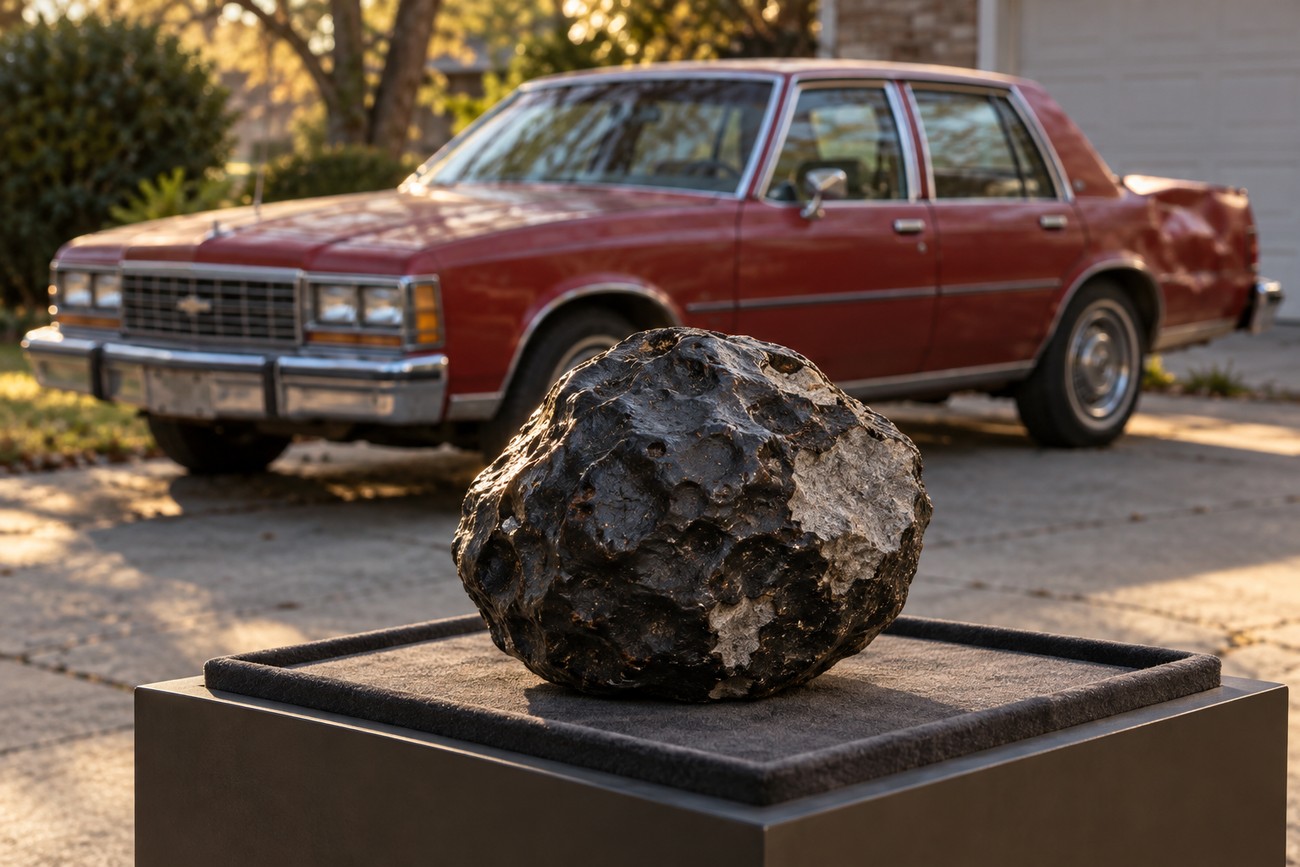
No reliable single value follows from the meteorite’s weight alone. The specimen’s ordinary-chondrite H6 classification, approximately 12–13 kg recovered mass, physical condition, documented fall status, display history, provenance, and the market context at the time of sale can all affect interest and price.
A documented fall may attract more attention than an otherwise similar find because its descent, recovery, and early history are better established. The Peekskill connection adds a recognizable historical narrative, but narrative value does not replace laboratory identification or a continuous chain of custody.
The meteorite’s value and the Chevrolet Malibu’s value are separate questions. Collectors may evaluate the stone’s scientific and historical importance, while an insurer or vehicle buyer would assess repair costs, structural condition, title history, and whether the damage can be safely repaired. A famous incident can increase interest in the car without making every restoration or ownership claim credible.
Insurance documentation would normally benefit from photographs, repair estimates, records of the impact, and evidence linking the recovered object to the event. The absence of a publicly established current owner, sale price, or present display location means those details should not be supplied as fact. The defensible conclusion is narrower: the fall is documented, the specimen is classified, and its final market value depends on evidence and circumstances beyond mass.
Frequently asked questions
What happened to the Chevrolet Malibu after the meteorite hit it?
The Malibu became part of the event’s historical documentation because its roof, windshield, and rear-area interior or trunk section recorded the strike. Public retellings often discuss the damaged car as an artifact, but the available record does not justify inventing a complete restoration history, a current owner, or a definite present museum location.
Claims about the vehicle’s later preservation or display should therefore be tied to a specific documented source. The impact evidence is well established; the car’s full later status is a separate question.
What is the Peekskill meteorite worth today?
There is no defensible fixed price based only on the approximately 12–13 kg mass. A serious valuation would consider the H6 classification, condition, documented fall status, provenance, specimen division or preparation, display history, and the market context of a particular transaction.
The famous car association may increase collector interest, but it does not create an automatic price. Any claimed current value should be supported by a documented sale or a qualified appraisal rather than inferred from the stone’s weight.
Was the owner definitely hit in the leg?
The leg-injury detail appears in popular accounts, but it is not consistently established or emphasized in scientific descriptions of the fall. It should be reported as an attributed media claim, not as settled scientific fact.
The documented core of the case is the witnessed fall, the damage to the Chevrolet Malibu, the recovery of the stone, and its classification as an ordinary chondrite, H6. Those facts do not require the injury claim to be treated as proven.







