
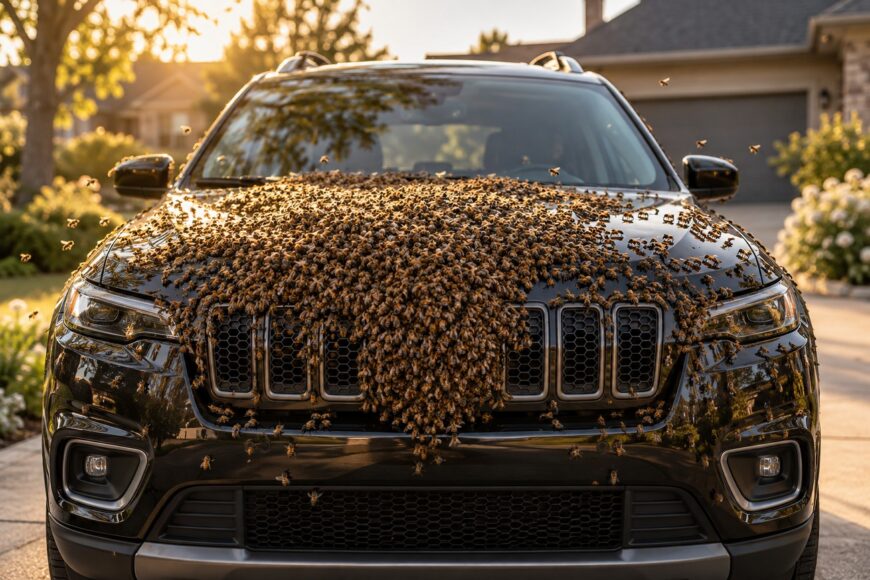
Finding a dense bee swarm covering your Jeep Cherokee is alarming, especially in a driveway, parking lot, or near children and pets. The vehicle may be impossible to use, and opening a door or walking around it can feel unsafe.
A temporary swarm is usually searching for a new cavity rather than defending an established nest. Swarming honey bees are generally less aggressive than bees defending a nest, but they are not harmless: serious disturbance can still trigger stings. Keep your distance, avoid provoking the cluster, and choose between waiting safely and calling a qualified beekeeper.
- Why Bees Swarm a Jeep Cherokee
- If a Swarm Is on Your Jeep: Do This First
- Removal Options: Waiting, a Beekeeper, or Emergency Help
- After the Swarm Leaves: Cleaning, Driving, and Prevention
- Frequently asked questions
- What month do bees stop swarming?
- What does it mean if a bee lands on your car?
- How can I tell whether bees are still inside my Jeep Cherokee?
Why Bees Swarm a Jeep Cherokee
A moving colony may settle on a Jeep because it needs a temporary resting point while scout bees search for a suitable home. A large vehicle provides a stable, exposed surface, particularly where there are few trees, walls, or other sheltered objects nearby.
Large, dark, contrasting vehicles can be especially noticeable in an open parking area. The swarm is usually treating the Cherokee as a temporary landing point, not as a nest. Unless bees begin entering a cavity, the visible cluster may remain mobile and leave when a better location is found.
This waiting period is usually a few hours to 1–2 days if no suitable cavity is found nearby. Swarming honey bees are generally less aggressive than bees defending an established nest, but they can still sting when seriously disturbed. Do not test their temperament by touching, brushing, or spraying them.
If a Swarm Is on Your Jeep: Do This First
Move people and pets away from the Cherokee by at least 1 metre. Close nearby doors and windows, keep children indoors, and ask others not to gather around the vehicle to take photographs. If anyone has a known severe allergy, keep that person well away and have appropriate medical help available.
Leave the cluster alone. Do not wave your hands, strike the bodywork, open doors beside the bees, or cover the swarm with fabric, plastic, or a blanket. Water and strong air blasts may scatter bees temporarily while making them harder to control, and neither method removes the queen or prevents regrouping nearby.
Do not use fuel, solvents, insecticide, smoke, or fire. These methods can create toxic fumes, a fire hazard, or an aggressive response, and smoke or loud activity may also cause public-order problems in an urban parking area. Contact a qualified beekeeper or specialist swarm-removal team, and tell them the vehicle’s location and whether anyone is trapped inside.
Driving away is not a default solution when the swarm is dense on the body, grille, mirrors, or roof. Bees may enter the cabin, fall onto the road, or endanger other road users. Air conditioning may slow individual bees inside the cabin, but it is practically ineffective against a swarm on the exterior.
Removal Options: Waiting, a Beekeeper, or Emergency Help
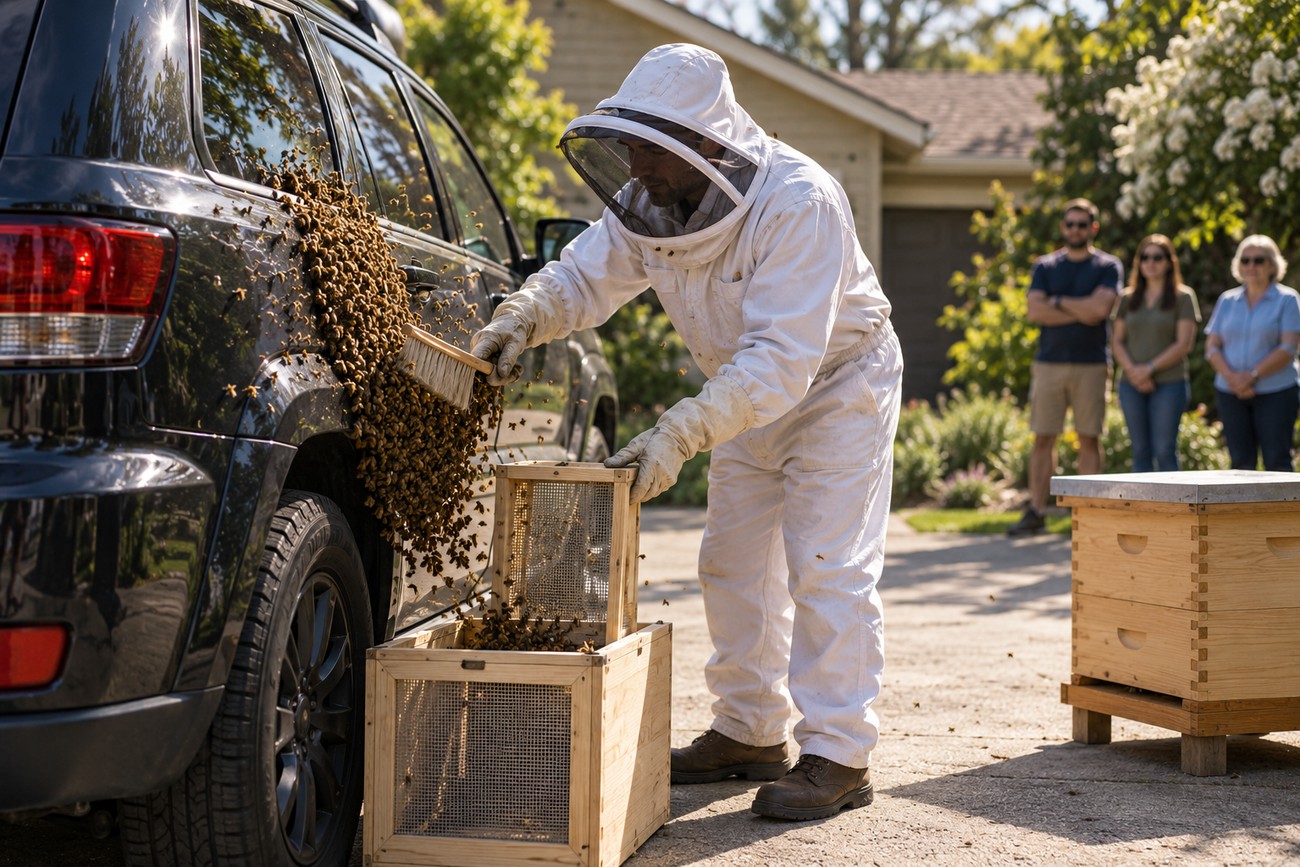
If the swarm is stable, no one is at immediate risk, and the vehicle can remain where it is, waiting at a safe distance may be reasonable. A swarm may leave on its own after scouts identify a cavity. Keep the area controlled while you arrange advice rather than repeatedly checking the cluster at close range.
A qualified beekeeper normally approaches with protective equipment, contains the cluster, and places the bees in a prepared hive or transport box. The preferred outcome is relocation into a hive. Police, fire services, property managers, or general maintenance teams may help secure the area, but they may lack the equipment and training needed for collection.
Locating or containing the queen is more useful than merely scattering visible workers. A prepared hive gives the colony somewhere to follow, while water, smoke, or air can leave the queen nearby and allow the bees to regroup.
Ask exactly what a company means by “humane removal.” The label does not guarantee relocation; confirm that the colony will actually be moved rather than destroyed. If water or airflow has already dispersed the bees, report where the cluster moved, since the queen may remain near the Jeep or in a nearby vent, roof space, or other cavity.
After the Swarm Leaves: Cleaning, Driving, and Prevention
Do not drive until the cabin is checked, ventilated, and free of visible bees. Inspect from outside first, then open the doors carefully and check the footwells, under the seats, door pockets, vents, and dark trim. A single hidden bee can create a dangerous distraction during traffic.
Wash the bodywork and likely landing areas after the swarm leaves. Remove honey, propolis, debris, and other residue from the grille, mirrors, roof edges, and door gaps. Cleaning helps restore visibility and reduces scent cues that could make the same surface attractive to another cluster.
Photograph the vehicle and surrounding area before cleaning if the swarm caused contamination or damage. Insurance commonly does not cover minor contamination or damage caused by panicked DIY actions, so check your policy rather than assuming the incident is covered. Tell neighbors or the property manager what has happened if the Jeep remains in a shared area.
Frequently asked questions
Bee activity varies with local conditions, and a single bee is not evidence that a colony is forming. These answers help separate an isolated visitor from a genuine swarm and explain how to make the Cherokee safe to use again.
What month do bees stop swarming?
There is no universal month when bees stop swarming. Timing changes with local climate, weather, and colony conditions, so a swarm should not be considered impossible outside the season familiar in your area.
For that reason, judge the situation by the bees’ behavior and cluster size rather than the calendar. A qualified local beekeeper can identify whether the group is a temporary swarm or a colony beginning to occupy a cavity.
What does it mean if a bee lands on your car?
One bee landing on a vehicle usually means little by itself. It may be investigating scent or color, resting, or passing through; an isolated bee does not show that a swarm or nest is forming.
Look for a sustained cluster, repeated traffic into one opening, or bees collecting around a cavity before treating the vehicle as a swarm problem. Even then, avoid disturbing them and seek local specialist advice if activity increases.
How can I tell whether bees are still inside my Jeep Cherokee?
Inspect from outside first, looking through the windows for bees in the footwells, under the seats, door pockets, vents, and dark trim. Open the doors only after the visible exterior cluster has gone, then ventilate the cabin and check the floors and seat edges again.
Do not drive if you see a bee, hear persistent buzzing, or cannot inspect a concealed area safely. Close the vehicle and arrange professional help rather than trying to reach into vents or trim with your hands.







